

Platform recommendation algorithms favour video because video generates richer, faster, and more monetisable engagement signals than any other content format. Watch time, completion rate, session duration, and replay behaviour are the inputs ranking models use to predict future engagement, and video produces all of them at scale. Text and images simply cannot compete on temporal depth. A photo is consumed in under two seconds; a 30-second clip can hold attention for its full duration, generating a continuous stream of implicit feedback the algorithm uses to refine its next recommendation.
The commercial logic reinforces the technical one. Longer sessions mean more ad impressions. Video-specific formats such as pre-roll and mid-roll carry higher CPMs than display. First-party behavioural data collected from video viewing is richer and more targetable than click data from static posts. Platforms are not neutral pipes; they are advertising businesses, and video is their highest-yield product.
Pro Tip: Front-load your hook in the first two to three seconds. Early swipe-away or scroll-past events are negative signals that suppress distribution before most of your audience ever sees the content.
Pro Tip: Never cross-post a watermarked clip from one platform to another. Instagram Reels, TikTok, and YouTube Shorts each penalise imported watermarks algorithmically, reducing reach before the content has a chance to perform.
Table of Contents
- How major platforms favour video: what each one actually optimises for
- Short-form vs long-form: when does each format win?
- Why platforms have a commercial incentive to push video
- What are the risks of a video-first recommender?
- How AI-driven short-video tools are changing creator economics
- Key takeaways
- The case for AI video: a creator’s perspective
- Squish: short-form AI video without the production overhead
- Useful sources and further reading
How major platforms favour video: what each one actually optimises for
YouTube
YouTube’s algorithm optimises primarily for expected watch time and session time, not raw view count. A video that keeps viewers on the platform after it ends, by triggering autoplay or surfacing related content, is weighted more heavily than one that generates a single long watch and then loses the user.
Practical implications: thumbnails and titles drive CTR, which determines whether the algorithm tests your video with a wider audience. The first 30 seconds determine whether viewers stay. Mid-roll ad placement correlates with longer content, which is why YouTube historically rewarded videos over ten minutes, though the signal is watch time, not length per se. Playlists extend session time by chaining videos together, which the algorithm reads as a positive signal for the creator’s entire catalogue.
TikTok
TikTok runs an exploration-first interest graph rather than a social graph. It does not require you to have followers to reach a large audience; it tests content with small pools of users and expands distribution based on completion rate and early engagement velocity. The first frame is critical: a swipe-away in the first second is a hard negative signal.

Native editing tools, trending audio, and on-platform text overlays all correlate with better distribution, partly because they signal that the content was made for TikTok rather than repurposed from elsewhere. Rapid iteration matters more here than on any other platform: posting frequently and testing different hooks is the most reliable way to find what the algorithm rewards for your specific audience.
Instagram Reels
Instagram Reels rewards front-loaded engagement: saves, shares, and early completion signals carry significant weight. Cross-posted content with visible watermarks from other platforms is algorithmically penalised, which is a direct product decision to protect the native format. Buffer’s content-format research confirms that platform-specific strategies remain the most reliable path to growth, and Reels is a clear example of that principle in action.
Captions matter on Reels because a large proportion of mobile users watch without sound. Native vertical format (9:16) performs better than cropped horizontal content. The Remix and Collab features generate additional engagement signals by connecting your content to existing high-performing clips.
LinkedIn’s video placements reward professional relevance and watch-through on native uploads. Externally hosted links, including YouTube embeds, receive significantly less organic reach than natively uploaded video. Subtitles are near-mandatory: LinkedIn’s audience skews towards office environments where audio is off by default.
The platform’s algorithm also weights early comments heavily, particularly from first-degree connections, so posting at times when your professional network is active (typically Tuesday to Thursday mornings in the UK) improves early velocity. Keep videos concise and front-load the professional insight rather than building to it.
Meta / Facebook
Meta has made video the centrepiece of its feed strategy, with Reels and Watch placements receiving preferential distribution over static posts. Platform reporting and journalistic coverage document how monetisation incentives have pushed platforms including Meta to emphasise video discovery and creator tools. Native uploads consistently outperform shared YouTube links in organic reach.
Facebook’s ad system benefits directly from video inventory: pre-roll and in-stream placements on Watch content carry higher CPMs than feed display ads. For marketers, this means video content serves a dual purpose: organic reach and a more valuable ad environment for paid amplification.
Google search and short-form video snippets
Google increasingly surfaces video carousels in search results, particularly for how-to, review, and entertainment queries. Short-form video from YouTube (including Shorts) can appear as rich snippets above standard organic results. Metadata is the lever here: accurate titles, descriptions, and timestamps (chapters) help Google understand what a video covers and when to surface it.
For UK creators, hosting video on YouTube rather than third-party platforms maximises the chance of appearing in Google’s video carousels, since YouTube is a Google property and benefits from tighter indexing integration.
UK scheduling note: for organic reach on LinkedIn and Instagram, posting between 8:00 AM and 10:00 AM GMT on weekdays aligns with the UK morning commute window, when mobile engagement peaks. TikTok’s UK audience tends to be most active in the early evening (6:00 PM to 9:00 PM GMT).
| Platform | Primary optimisation signal | Key creator action |
|---|---|---|
| YouTube | Watch time + session time | Strong thumbnail, 30-second hook, playlist chaining |
| TikTok | Completion rate + early velocity | First-frame hook, native editing, rapid iteration |
| Instagram Reels | Front-loaded engagement + shares | No watermarks, captions, native vertical format |
| Watch-through + professional relevance | Native upload, subtitles, post during UK work hours | |
| Meta / Facebook | Video session time + ad inventory | Native upload, Reels placement, in-stream ad eligibility |
| Google Search | Metadata relevance + YouTube hosting | Accurate titles, descriptions, video chapters |
Short-form vs long-form: when does each format win?
The most common question creators ask about YouTube is whether the algorithm favours longer videos. The honest answer: YouTube favours watch time, not length. A 20-minute video that loses 60% of viewers after five minutes generates less watch time than a tight eight-minute video watched to completion. Length is a proxy; the underlying signal is how much of your content people actually consume.
That said, longer content does create structural advantages in specific contexts. A 15-minute video has more opportunity to accumulate absolute watch time, can include mid-roll ads (which require a minimum length threshold), and can chain into a playlist that extends session time. For subscriber growth and brand depth, long-form tends to outperform short-form because it gives the algorithm more behavioural data per viewer.
Short-form has a different set of advantages:
- Discovery: completion rates on 30–60 second clips are structurally higher than on 10-minute videos, which the algorithm reads as a strong positive signal.
- Iteration speed: you can test ten short-form hooks in the time it takes to produce one long-form piece.
- Cross-platform reach: short-form travels across TikTok, Reels, Shorts, and LinkedIn video with minimal adaptation.
- Cold-start performance: new creators reach audiences faster with short-form because the algorithm’s test pools are smaller and completion is easier to achieve.
Long-form advantages are real but narrower:
- Deeper audience relationships and higher subscriber intent
- Session time extension through playlists and autoplay
- Mid-roll ad eligibility on YouTube
- Better performance for complex topics where depth signals expertise
| Dimension | Short-form (under 3 minutes) | Long-form (10+ minutes) |
|---|---|---|
| Completion rate | Higher (structurally easier to complete) | Lower (requires sustained attention) |
| Discovery reach | Broader (exploration-first algorithms) | Narrower (relies more on subscribers) |
| Session time contribution | Lower per video | Higher per video |
| Ad revenue potential | Lower CPM, higher volume | Higher CPM (mid-roll), lower volume |
| Iteration speed | Fast (multiple tests per week) | Slow (one piece per week or less) |
| Best for | New audiences, trend capture, AI-generated clips | Depth, subscriber growth, brand authority |
The practical rule: use short-form to find your audience and test what resonates, then use long-form to deepen the relationship with the audience that responds. AI entertainment platforms available in the UK are increasingly built around this short-form-first logic, lowering the barrier to rapid iteration.
Why platforms have a commercial incentive to push video
The algorithmic preference for video is not accidental. It is the product of deliberate design choices made by platform product teams whose primary objective is revenue growth. Understanding the commercial logic helps creators anticipate where platforms will invest their distribution boosts next.
Video creates ad inventory that static formats cannot. Pre-roll ads play before a video begins; mid-roll ads interrupt longer content at natural pause points; interactive overlays appear during playback. Each of these formats commands a higher CPM than a feed display ad, because the viewer’s attention is already locked onto the screen. A platform that shifts its feed from 30% video to 70% video does not just change the user experience; it materially increases its ad yield per session.
First-party data is the second commercial driver. As third-party cookies have been phased out across browsers, platforms have leaned harder into the behavioural data they collect directly from users. Video viewing generates far richer behavioural signals than static browsing: which topics hold attention, at what point interest drops, which creators drive the deepest engagement. That data improves ad targeting, which improves advertiser ROI, which increases ad spend on the platform.
There is also a product-design lever that creators often miss. When a platform launches a new video format (Shorts, Reels, Stories), it typically provides a temporary distribution boost to accelerate adoption. Early adopters of that format receive disproportionate reach until the format reaches saturation. HubSpot’s state of video marketing research shows that AI adoption in video workflows is increasing rapidly among marketing teams, with generative AI used for pre-production and captioning, which makes scaling into new formats faster and cheaper than it was two years ago.
The creator economics shift that follows is documented in platform reporting: as video monetisation tools (channel memberships, tipping, in-stream ads) mature, platforms attract more professional creators, which improves content quality, which improves session time, which improves ad revenue. It is a self-reinforcing cycle, and video is the engine running it.
What are the risks of a video-first recommender?
Optimising for video engagement is not without cost. Creators and strategists who build entirely around algorithmic video distribution take on several structural risks.
Creator volatility is the most immediate. Algorithmic reach can collapse overnight when a platform updates its ranking weights, launches a competing format, or changes its content policy. Creators who have built their entire audience on a single platform’s video feed have no buffer when that happens.
Amplification of polarising content is a documented systemic risk. Academic research published in ScienceDirect models how engagement-weighted ranking increases polarisation, because emotionally charged content tends to generate higher engagement signals regardless of its accuracy or social value. Theoretical models on arXiv describe the feedback loop dynamics that make this self-reinforcing: content that generates strong reactions gets more distribution, which generates more reactions, which gets more distribution.
Production resource burden is a practical constraint. Video requires more time, equipment, and skill than text or image content. Teams that commit to a video-first strategy without accounting for production costs often find that quality drops as volume increases.
Platform dependence is the strategic risk that compounds all the others. A creator whose revenue depends entirely on algorithmic reach has no control over their distribution. One policy change can eliminate years of audience building.
Two practical mitigations:
- Diversify formats and distribution channels — Use video as your primary discovery mechanism, but maintain an email list, a community platform, or a secondary content format (long-form articles, carousels) that does not depend on algorithmic reach. Buffer’s guidance on content formats specifically recommends keeping secondary formats for depth and community, even in a video-first strategy.
NSFW and AI-generated content carries additional considerations for UK creators. Content that includes nudity, adult themes, or AI-generated imagery is subject to the Online Safety Act 2023, which places obligations on platforms to implement age verification and content moderation for adult material. Creators producing NSFW AI video should use platforms with explicit consent-first policies, clear content labelling, and robust moderation tools. Uploading AI-generated adult content without the subject’s consent (where a real person is depicted) is a legal risk under UK law. Always use original AI-generated characters, consenting adult uploads, or fantasy art that does not depict real identifiable individuals without their permission.
Pro Tip: For NSFW or adult AI video content, always use platforms that enforce consent-first policies and provide explicit content controls. In the UK, the Online Safety Act 2023 applies to platforms hosting adult material, and creators share responsibility for ensuring their content meets those standards.
How AI-driven short-video tools are changing creator economics
The production cost of short-form video has dropped sharply as AI tools have matured. A workflow that once required a camera operator, editor, and motion graphics artist can now be compressed into a single creator with the right toolset. HubSpot’s research shows that AI is now commonly used in pre-production and for captioning and dubbing, making video-first strategies scalable for teams of any size.
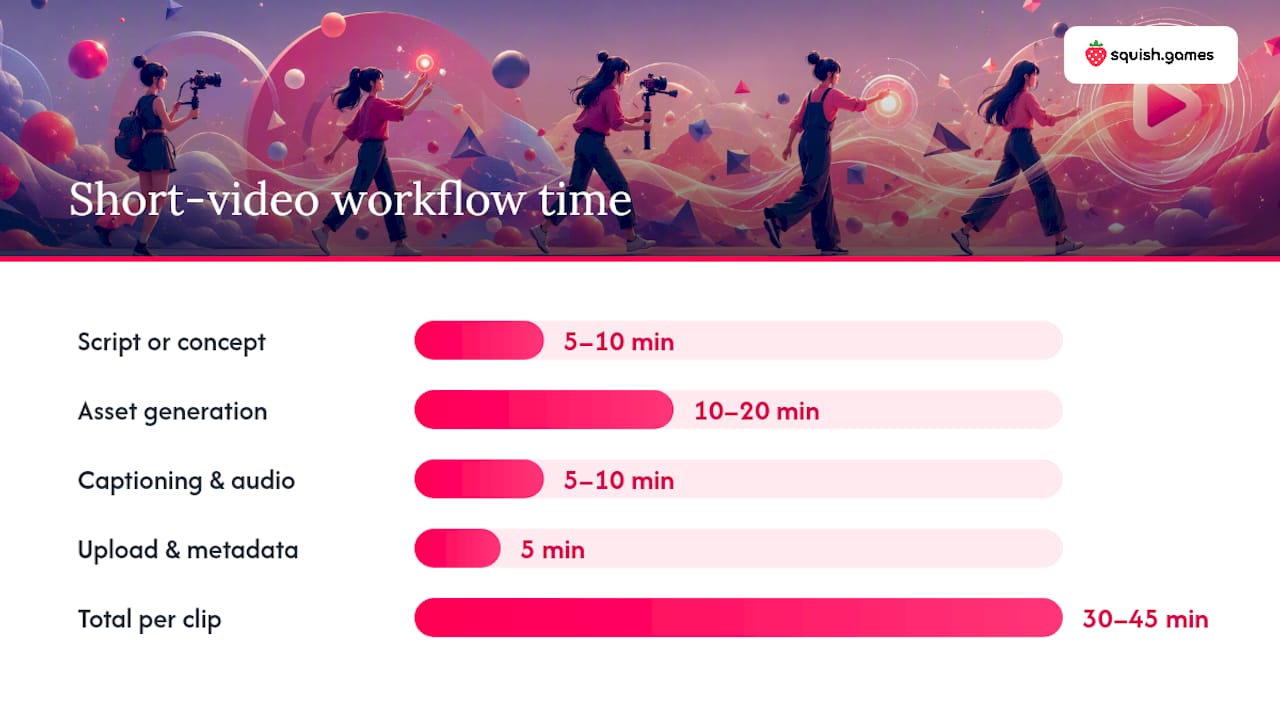
A practical AI-assisted short-form workflow looks like this:
- Script or concept (5–10 minutes): write a 30–60 second script or define the visual concept. AI writing tools can accelerate this, but the hook must be human-tested.
- Asset generation (10–20 minutes): use an AI image-to-video platform to generate the visual content. Upload a photo, AI character, avatar, or original artwork and animate it into a short clip. Squish’s AI video creation guide for non-technical creators covers this step in detail.
- Captioning and audio (5–10 minutes): add auto-generated captions (most platforms now offer this natively) and select audio. Captions are non-negotiable for mobile-first audiences watching without sound.
- Native upload and metadata (5 minutes): upload directly to each platform rather than cross-posting. Write a platform-specific description and add relevant hashtags.
- First-hour monitoring (ongoing): check view velocity and early completion signals. If velocity is low, test a different thumbnail or first frame before the algorithm’s test pool closes.
Total time per clip: 30–45 minutes with an AI-assisted workflow, compared to several hours for a traditionally produced video.
Quality versus quantity checklist for AI-generated short-form video:
- Hook must be visible and compelling in the first two to three seconds (no slow fade-ins or title cards)
- Captions are accurate and timed correctly (auto-captions often need a quick review pass)
- Frame rate is consistent and appropriate for the platform (24fps for cinematic feel, 30fps for standard social)
- Content is original or properly licensed (no third-party watermarks, no identifiable real people without consent)
- For NSFW material: consent documentation is in place, content is correctly labelled, and the platform’s adult content policies are followed
- Audio levels are normalised (platforms compress audio; record or generate at a consistent level)
The faceless video creation approach is particularly relevant here: AI-generated characters, animated avatars, and abstract art clips can all perform strongly on short-form platforms without requiring the creator to appear on camera. This opens the format to creators who want to produce AI art, nude art, fantasy characters, or NSFW content while maintaining a degree of creative distance from the output.
Squish is built precisely for this workflow. Upload an AI image, a pet photo, an avatar, or a fantasy character, and the platform generates a short animated clip ready for social sharing, with no editing skills required. For creators testing AI image animation best practices, the iteration speed is the key advantage: you can test five different animated hooks in the time it takes a traditional editor to finish one.
Key takeaways
Platform algorithms favour video because it generates the continuous, monetisable engagement signals that ranking models are built to optimise for, and every major platform’s commercial incentives reinforce that structural preference.
| Point | Details |
|---|---|
| Signals drive ranking | Watch time, completion rate, and view velocity are the primary inputs; video produces all three at a depth static formats cannot match. |
| Platform motives align | Ad inventory, session time, and first-party data collection all improve when video dominates the feed, giving platforms a direct commercial reason to favour it. |
| Format choice matters | Short-form wins on discovery and completion; long-form wins on session time and subscriber depth. Match format to objective, not habit. |
| Risks are real | Creator volatility, polarisation amplification, and platform dependence are structural risks; diversify formats and measure business outcomes alongside reach metrics. |
| Squish accelerates iteration | Squish’s AI video platform lets creators animate photos, avatars, and AI art into short clips without editing skills, enabling rapid short-form testing at low production cost. |
The case for AI video: a creator’s perspective
The conventional wisdom on video strategy tends to focus on production quality: better cameras, tighter edits, higher production values. That framing misses the more important variable, which is iteration speed. The creators who consistently win algorithmically are not the ones with the best equipment; they are the ones who test the most hooks, learn the fastest, and adapt before their competitors notice the pattern has shifted.
AI video tools change the economics of that iteration loop. When generating a short animated clip from an image takes 20 minutes rather than two hours, you can run five tests in a day instead of one test a week. That compounding advantage is what makes AI-assisted short-form video the most practical response to how recommendation algorithms actually work, not a shortcut, but a genuine acceleration of the feedback cycle that platforms reward.
The ethics dimension matters too, particularly for creators working with AI-generated imagery, nude art, or NSFW content. Consent-first creation is not just a legal obligation under UK law; it is the foundation of a sustainable creative practice. AI characters, fantasy art, and original AI-generated imagery give creators enormous expressive freedom without the risks that come from depicting real people without permission. Squish is built around that principle: the platform is designed for original images, consenting adult uploads, AI-generated characters, and creator-owned content. That is not a restriction; it is a creative framework that keeps creators on the right side of both the law and their audience.
The gap between what most video strategy guides recommend (post more, post consistently) and what actually moves algorithmic distribution (signal quality, hook strength, early velocity) is wider than most creators realise. Closing that gap requires understanding the mechanics, not just the tactics. The mechanics are what this article has tried to lay out.
Squish: short-form AI video without the production overhead
Short-form video is the format algorithms reward most consistently, but producing enough of it to run meaningful tests has always been the bottleneck. Squish removes that bottleneck. Upload a photo, AI image, avatar, pet, fantasy character, or original artwork, and Squish generates a short animated clip ready for TikTok, Reels, YouTube Shorts, or LinkedIn, with no editing skills required and no expensive software.

For creators working with AI art, nude art, dancing videos, or NSFW content, Squish operates on a consent-first basis with explicit content controls, making it one of the few platforms where adult AI video creation is both accessible and responsibly managed. The free-to-start model means you can test your first clips immediately; paid credits unlock additional generations and premium effects when you are ready to scale. Whether you are building a video art portfolio or simply want to see what your AI characters look like in motion, the starting point is a single upload. Try Squish free at squish.games and generate your first animated clip today. Content is subject to Squish’s platform policies and UK legal requirements; adult content access requires age verification.
This article provides general information about platform algorithms and content strategy. It is not legal or professional advice. For guidance on UK content law and the Online Safety Act 2023, consult a qualified legal professional or refer to Ofcom’s published guidance.
Useful sources and further reading
- Buffer — data-driven guidance on content formats
- Statista — YouTube Shorts: total daily views
- The Verge — coverage of platform algorithm shifts and creator economics
- KnightColumbia — understanding recommendation algorithms
- arXiv — theoretical models of recommendation feedback loops
- Hootsuite — how the YouTube algorithm works
- HubSpot — state of video marketing 2026
- ScienceDirect — analysis of engagement-based ranking and social effects
Leave a Reply