

Early AI adoption among influencers is defined by one core motive: doing more with less time. As of 2026, 86–92% of creators use AI tools in some capacity. That figure alone signals a structural shift, not a passing trend. The creators earning six figures are not just experimenting. They are using AI daily and weekly at rates far above their smaller peers, because for them, time is a direct financial resource. Understanding why influencers adopt AI early means understanding the economics of attention, output, and scale.
Why influencers adopt AI early: time, output, and scale
The single biggest reason creators embrace AI is production speed. Tasks that once took hours now take minutes. Video scripting, caption writing, thumbnail generation, and audio clean-up all compress dramatically with AI assistance. For a creator publishing across Instagram, TikTok, YouTube Shorts, and LinkedIn simultaneously, that compression is the difference between a sustainable business and burnout.

AI avatars and voice cloning push this further. One LinkedIn creator reached 60 million views within a few months by switching from manual recording to AI avatar-generated videos. The workflow shift was simple but profound: instead of recording, reviewing, and re-recording, the creator reviewed and refined AI-generated outputs. Production time dropped from hours to minutes per video.
The practical benefits of AI for influencers in this area include:
- Scripting automation: AI drafts video scripts from a topic prompt, cutting ideation time significantly.
- Voice cloning: Creators record once and generate multiple language or tone variants without re-recording.
- Multi-platform repurposing: A single long-form video becomes ten short clips, a blog post, and a carousel, all generated with AI assistance.
- Thumbnail and visual generation: AI produces multiple visual options in seconds, removing the need for a separate designer.
- Scheduling and caption writing: AI tools draft captions, suggest hashtags, and schedule posts across platforms from one dashboard.
Pro Tip: Start repurposing before you create. Write your script with AI, then instruct the same tool to generate a short-form version, a caption, and a thread simultaneously. You get four pieces of content from one session.
The workflow evolution from raw recording to post-production review is the most underreported shift in creator productivity. Creators who make this switch report doubling their posting frequency without adding working hours.
How income level shapes AI adoption patterns
AI adoption by influencers follows a clear economic gradient. The more a creator earns, the more they invest in AI tools, and the more frequently they use them. 43% of six-figure creators use AI weekly, compared to 28% of nano creators. At the daily usage level, the gap widens further: 29% of six-figure creators use AI every day, versus just 9% at the nano tier.
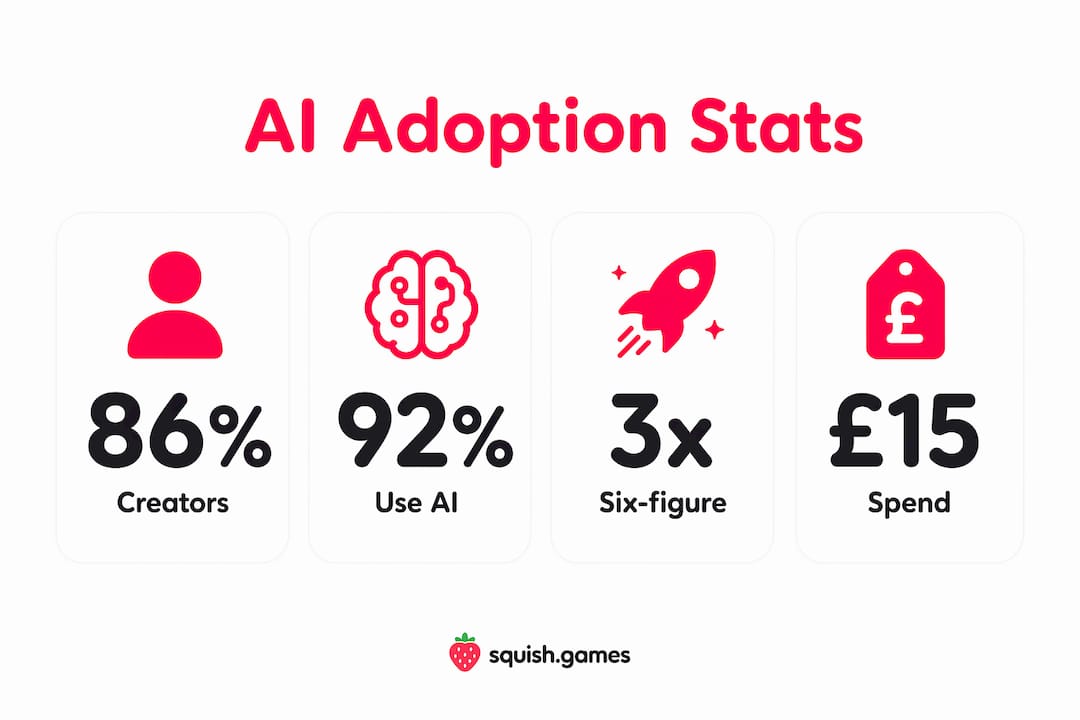
Spending reflects the same pattern. Nano creators typically spend nothing or up to £15 per month on AI tools. Six-figure creators invest £250–£600 monthly, purchasing the equivalent of 20–40 hours of professional production work. That is not a hobby expense. It is a calculated business decision.
| Creator tier | Weekly AI usage | Monthly AI spend |
|---|---|---|
| Nano creators | 28% | £0–£15 |
| Mid-tier creators | Rising sharply | £50–£150 (est.) |
| Six-figure creators | 43% | £250–£600 |
Mid-tier creators are arguably the most aggressive adopters. Mega-celebrities have full production teams and do not need to replace labour with AI. Nano creators lack the revenue to justify paid stacks. Mid-tier creators sit in the sweet spot: enough income to invest, enough ambition to scale, and enough output pressure to make AI genuinely necessary. For them, the benefits of AI for influencers are not theoretical. They show up directly in brand partnership rates and audience growth metrics.
What roles does AI play in influencer marketing?
AI’s role in influencer marketing extends well beyond content creation. By 2026, marketing teams use AI across four distinct functions: discovery, production, distribution, and measurement.
- Discovery: AI ranks creator candidates by engagement rate, audience demographics, brand-safety scores, and cost efficiency. This removes weeks of manual vetting from campaign planning.
- Production: Generative AI tools produce content briefs, concept variations, and first-draft scripts in minutes. Brands send creators structured briefs generated by AI, reducing back-and-forth by a significant margin.
- Distribution: AI predicts which content formats will perform on which platforms at which times. Creators and brands use these predictions to schedule posts for maximum reach.
- Measurement: AI attribution models connect specific pieces of content to downstream conversions, giving brands clearer ROI data than traditional last-click models.
Brands are also treating AI personas as premium assets alongside human talent. A single shoot day can generate 50–200 content variants using AI persona technology. That scale eliminates scheduling conflicts, removes talent reputation risk, and makes campaign costs predictable. Human influencers who understand this dynamic position themselves as creative directors of their own AI-assisted output, rather than fearing replacement.
The types of AI clips available to creators now cover everything from animated portraits to dancing avatars, giving influencers a genuinely broad production toolkit without requiring editing expertise.
What are the real risks of early AI adoption?
Early adoption carries genuine risks that creators must take seriously. Misleading AI-generated content is the most pressing. In 2026, cases of AI-fabricated videos have triggered public doubt and regulatory scrutiny for the influencers involved. Reputational damage from synthetic content, even unintentional, can end brand partnerships and erode audience trust rapidly.
AI also has hard limits in cultural nuance and lived experience. Human perspective remains indispensable for content that requires genuine community connection. An AI can write a script about grief, mental health, or cultural identity. It cannot replace the authenticity that comes from a creator who has actually lived those experiences. Audiences notice the difference, even when they cannot articulate why.
“AI automation excels at low-judgement tasks like research and workflow scheduling. It cannot replicate the human creative judgement and cultural nuance that build authentic community trust. The creators who thrive are those who use AI for the former and protect the latter fiercely.”
Consumer trust is also a disclosure issue. Regulators in multiple markets are moving towards mandatory AI content labelling. Creators who disclose AI use proactively build credibility. Those who obscure it face growing legal exposure.
Pro Tip: Add a simple, consistent disclosure to AI-assisted posts. Something as brief as “created with AI assistance” takes three seconds to write and protects your credibility for years.
How to start embracing AI as a creator in 2026
Getting started with AI does not require a large budget or technical skills. The most effective entry point is platform-native freemium tools, which carry no upfront cost and integrate directly into existing workflows.
- Start with free tools. Most major platforms now include native AI features for captions, editing, and scheduling. Use these before spending anything on paid stacks.
- Automate scripting first. AI scripting tools produce first drafts from a topic and tone prompt. Review, personalise, and publish. This single habit saves hours per week.
- Repurpose every piece of content. Use AI to convert long-form videos into short clips, blog posts, and social captions. One piece of content becomes five with minimal extra effort.
- Experiment with AI avatars. For creators comfortable with the format, AI avatar creation removes the need to appear on camera for every post, enabling higher posting frequency without physical fatigue.
- Blend AI with your personal voice. Always review AI outputs and inject your own perspective, humour, or lived experience before publishing. This is what separates forgettable AI content from content that builds genuine loyalty.
- Disclose clearly and consistently. Build disclosure into your content template from day one. Transparency with your audience is a long-term asset, not a liability.
The creators who scale fastest with AI are not those who automate everything. They are those who identify which parts of their workflow drain time without adding creative value, and automate those parts specifically.
Key takeaways
Early AI adoption among influencers is driven by economic incentives, with six-figure creators investing heavily in AI tools to reclaim time, scale output, and increase brand partnership returns.
| Point | Details |
|---|---|
| Adoption is near-universal | 86–92% of creators use AI tools in 2026, with six-figure earners leading daily usage. |
| Income drives investment | Six-figure creators spend £250–£600 monthly on AI, treating it as a production cost, not a hobby. |
| Four core marketing roles | AI assists influencer discovery, content production, distribution timing, and campaign measurement. |
| Authenticity remains human | AI handles workflow and research; human creativity and lived experience build audience trust. |
| Disclosure protects creators | Proactive AI content labelling builds credibility and reduces legal exposure as regulation tightens. |
AI in influencer content: what I actually think
The conversation around AI and influencers tends to split into two camps: breathless enthusiasm or existential panic. Neither is useful. What I have observed is something more interesting and more practical.
The creators who benefit most from AI are not the ones chasing every new tool. They are the ones who made a clear decision about where their time is most valuable. For most mid-tier creators, that value sits in community interaction, storytelling, and on-camera presence. Everything else, scripting, editing, repurposing, scheduling, is a candidate for automation.
What strikes me about the six-figure adoption data is what it implies about mindset. High-earning creators do not use AI because they are tech enthusiasts. They use it because they have quantified what an hour of their time is worth, and they refuse to spend it on tasks a machine can handle. That is a business decision, not a creative one.
The risk I see most often is creators automating their voice away. AI can mimic tone, but it cannot replicate the specific, personal, slightly imperfect quality that makes a creator’s audience feel genuinely seen. The moment a feed starts feeling like it was written by a committee, engagement drops. The best use of AI is to free up more time for the human parts, not to replace them.
My honest advice: treat AI as a production assistant, not a content strategist. Give it the repetitive work. Keep the thinking for yourself.
— Jason
Squish: AI video creation for creators who just want to create
If you are ready to put AI to work on your content, the barrier to entry is lower than you think. Squish is a free-to-start AI video and interactive art platform that turns photos, avatars, AI characters, and original images into short, shareable videos with no editing skills required.

Upload a selfie, a fantasy character, a pet, or an AI-generated image, and Squish animates it into a dancing video, a bouncing photo effect, or a jiggly interactive clip built for social sharing. Whether you want to create fun content, expressive nude art, or playful AI animations, Squish handles the technical side completely. The 2026 guide to AI video creation covers everything you need to get started today, no prior experience necessary.
FAQ
Why do influencers adopt AI earlier than other content creators?
Influencers face constant pressure to publish across multiple platforms simultaneously. AI tools reduce production time dramatically, making early adoption a direct competitive advantage in audience growth and brand partnership rates.
What percentage of creators use AI tools in 2026?
Between 86% and 92% of creators use AI tools as of 2026. Six-figure earners use AI daily at three times the rate of nano creators, reflecting a strong link between income level and adoption intensity.
What are the biggest benefits of AI for influencers?
The primary benefits include faster scripting, automated video editing, multi-platform content repurposing, and AI-assisted influencer discovery for brand campaigns. These gains compound over time as creators build efficient AI-assisted workflows.
Does AI-generated content damage an influencer’s authenticity?
AI-generated content risks authenticity only when it replaces human voice entirely. Creators who use AI for production tasks while maintaining personal storytelling and clear disclosure consistently retain audience trust.
How much do creators spend on AI tools monthly?
Spending varies sharply by tier. Nano creators typically spend nothing to £15 per month. Six-figure creators invest £250–£600 monthly, treating AI tool costs as a standard production expense with measurable ROI.
Leave a Reply