

AI videos are replacing traditional photo albums because they do something a static image never could: they make a memory move. A photograph of your grandmother smiling is touching. That same photograph animated, with subtle motion and music, feels like she is in the room. That gap in emotional impact is why short-form video now dominates how people consume content online, and why users are increasingly turning their photo libraries into shareable, living stories.
The core reasons are straightforward:
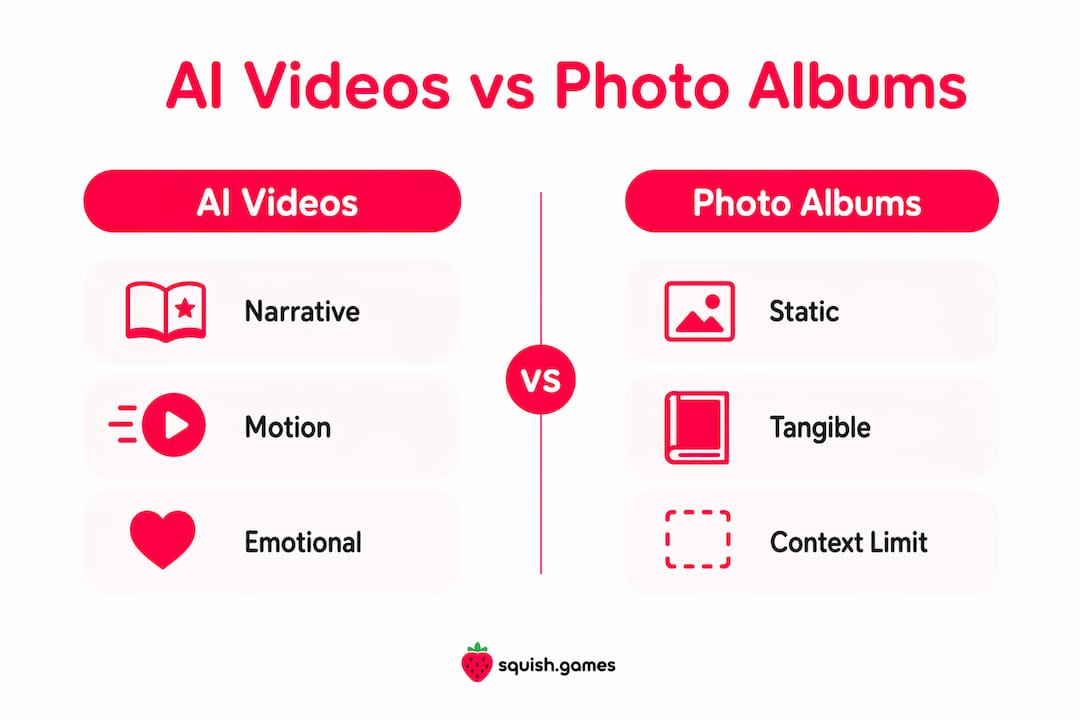
- Static photos require the viewer to construct the story. AI videos tell it.
- Social feeds are built around motion. A still image competes poorly.
- AI tools have collapsed the technical barrier. No editing skills needed.
- Video preserves mood, music, and narrative arc. Albums preserve only the image.
- Physical albums still serve archival roles, but AI videos win on engagement and shareability.
How AI technology turns photos into dynamic videos
The engine behind this shift is machine learning. Google Photos now uses the Veo 2 AI model to animate still images into six-second clips, bringing photo-to-video creation directly into a mainstream consumer app. Users simply select a photo, choose a motion style, and the AI handles the rest, creating dynamic clips ready to share.
Beyond animation, AI automates music syncing, narrative pacing, and post-production. Audio synchronisation aligns cuts to a soundtrack’s rhythm, a technique that once required a skilled editor. Now it happens in seconds on a smartphone. Platforms like Squish extend this further, letting anyone upload a selfie, pet photo, or AI-generated character and watch it bounce, dance, or move without touching a timeline.
Mobile-first tools have been decisive. When creation requires nothing more than a phone and a photo, adoption accelerates fast.

Why people feel more connected to AI videos than photo albums
The emotional pull of animated family photos is not nostalgia for nostalgia’s sake. It is about intimacy. A portrait that blinks or smiles back at you triggers a different kind of recognition than a flat print. Users report that old photographs feel immediate and personal again once motion is added, particularly images that had spent years in a box or an album.

Social media culture has reinforced this. Feeds built around motion train users to expect it everywhere. A still image in that context can feel incomplete. AI-generated clips of personal photos flood platforms like TikTok, and the content that travels furthest carries mood, atmosphere, and a sense of occasion that no grid of thumbnails can match.
Nostalgia-based content consistently generates strong engagement because it encourages people to share personal stories. Animated family photos attract more attention online than conventional AI demonstrations precisely because the transformation is immediately legible: a still becomes a moment.
What AI video storytelling does that photo albums cannot
The performance gap between a video and a photo album comes down to narrative structure. A highlight reel has a setup, a climax, and a resolution. A photo album has a chronological order and nothing else. The viewer of an album does all the emotional work. The viewer of a well-made AI video is guided through it.
Companies report significant reductions in production time using AI video tools, with similar efficiency gains available to personal creators. Faster production means more iteration, more sharing, and more content that actually gets watched. For creators exploring AI video benefits, the payoff is real: higher completion rates, more shares, and content that platforms actively promote.
Music-synced pacing is the detail most people underestimate. When a cut lands on a beat, the viewer feels it before they process it consciously. That physical response is what makes a reel memorable and a photo album forgettable.
Mainstream AI tools bringing photo animation to everyone
Google Photos is the clearest example of how quickly this technology has reached ordinary users. Its Photo to video feature animates a chosen image into a six-second clip using Veo 2, with prompt options such as “Subtle movements” or “I’m feeling lucky.” The Remix tool transforms photos into anime, comic, or 3D animation styles. Both embed an invisible SynthID digital watermark, plus a visible one on videos, for transparency.
“Your photo library in Google Photos is more than an archive, it’s a canvas.” — Google Photos team, 2026
Watermarking matters. As AI-generated content floods major platforms, audiences are getting faster at separating creative work from disposable output. Transparency tools help maintain trust. For those wanting to go further, platforms built around playful, consent-first animation, including Squish, complement what mainstream apps offer by supporting a broader creative range, from fantasy art to NSFW content, with no editing experience required. You can explore AI drama generation as another route for longer-form animated storytelling.
Privacy and ethical considerations of AI photo processing
Uploading personal photos to any AI platform carries real privacy implications. Images processed by cloud-based models may be used to train future systems unless users explicitly opt out. Reading the terms of service before uploading family photographs is not optional caution; it is basic digital hygiene.
Consent is the other pressure point. Animating a photo of someone else, particularly a deceased relative or a child, raises questions that technology cannot answer. Platforms that embed watermarks, like Google Photos with SynthID, at least make AI-generated content identifiable. Consent-first platforms go further by requiring that uploaded content belongs to the creator or has been shared with permission.
How memory preservation evolved to reach AI video
Painted portraits gave way to daguerreotypes in the 1840s. Daguerreotypes gave way to printed photographs. Printed photographs gave way to digital camera rolls. Each transition preserved more, cost less, and reached more people. AI video is the current step: it adds motion, music, and narrative to images that previously sat static in a folder or a box.
Physical albums remain genuinely valuable. They do not require electricity, accounts, or file formats. They survive power outages and technology generations. The mistake is treating them as a complete preservation strategy. Digital archives add context, voice, and searchability that a printed page cannot hold. AI video adds the emotional layer on top.
How social media accelerated the move from albums to video
Platform algorithms do not treat photos and videos equally. Watch time, completion rate, and share behaviour all favour video. A fifteen-second clip that holds a viewer to the end signals quality to the algorithm. A photo is comprehended in a second and scrolled past. The result is structural: creators who want reach post video, and audiences trained on video feeds find static images less compelling over time.
HubSpot’s 2026 marketing data confirms that short-form video is the most-used media format among marketers, with the top three ROI-driving formats all being video-based. That shapes not just brand strategy but what ordinary users expect to see every day. Once the feed is built around motion, the photo album feels like a different medium entirely.
What makes traditional photo albums genuinely hard to replace, and where they fall short
Albums are tangible. You can hand one to a child, flip through it with a grandparent, and feel the weight of it. No app replicates that. They also do not require a subscription, a charged device, or an internet connection. For archival permanence, a well-stored physical album outlasts most digital formats.
Where they fail is context and engagement. A photo captures what something looked like. It rarely captures why it mattered, who else was there, or what happened next. The story dies when the person who remembers it does. AI video does not solve that problem entirely, but it adds atmosphere, motion, and emotional cues that pull a viewer in rather than leaving them to do all the interpretive work alone. For anyone wanting to animate still photos without technical skills, the gap between album and video has never been smaller.
Squish: bring your photos to life with bold AI video
Squish is the free-to-start AI video platform for people who want their photos to actually do something. Upload a selfie, a pet portrait, a fantasy character, or an AI-generated image, and Squish turns it into a dancing clip, a bouncing animation, or a jiggly short video ready to share. No editing timeline. No technical knowledge. Just a photo and a result.
Where mainstream tools like Google Photos offer subtle animation, Squish goes further: it supports the full creative range, from playful family content to bold NSFW and nude art, all on a consent-first platform. Creators, artists, and anyone curious about AI video creation without editing skills will find Squish built exactly for that. Check the top-rated videos this week to see what the community is making, or dive straight into the free adult AI video maker for NSFW-appropriate content. Bold, playful, and updated through 2026.
Key takeaways
AI videos replace photo albums because they deliver narrative, motion, and emotional impact that static images structurally cannot, and AI tools have made that transformation available to anyone with a smartphone.
| Point | Details |
|---|---|
| Video dominates feeds | Short-form video is the most-used media format online, making static photos less competitive for attention. |
| AI cuts production time | AI video tools significantly reduce production time, making personal video creation fast and affordable. |
| Narrative beats catalogue | AI videos use setup, climax, and resolution; photo albums leave all narrative construction to the viewer. |
| Albums still have a role | Physical albums offer archival durability and tangibility that digital formats have not fully replaced. |
| Squish extends the range | Squish lets anyone animate photos into shareable AI videos, including NSFW and fantasy content, with no editing skills. |
Leave a Reply