

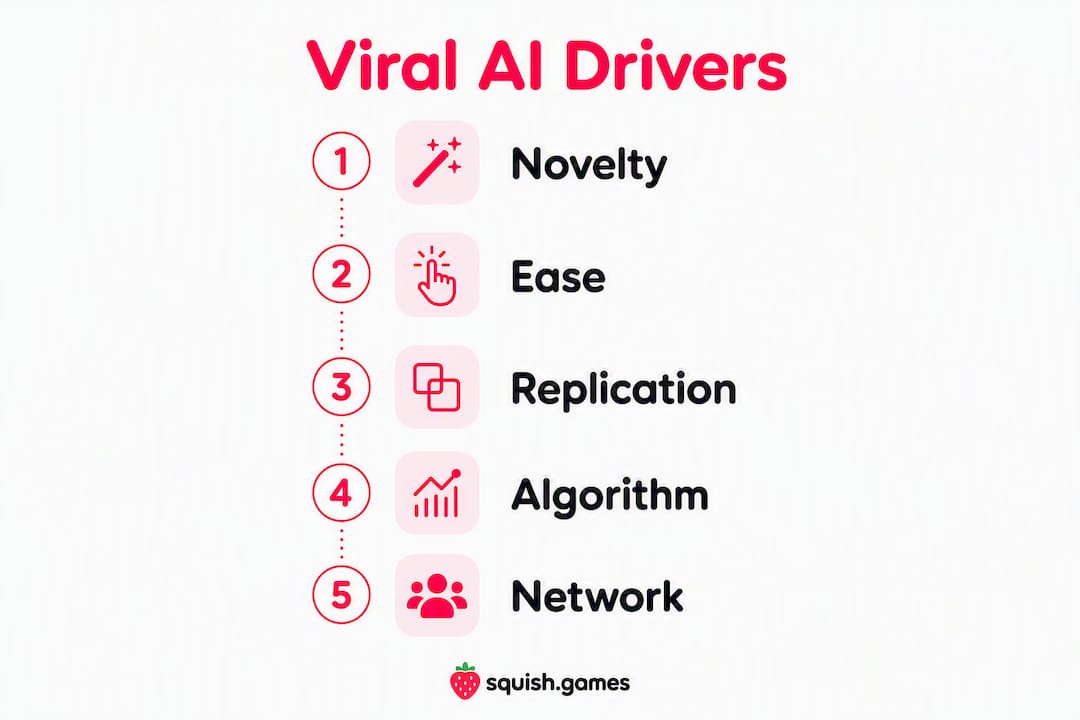
AI selfie tools go viral because they deliver three things at once: a genuine “whoa” moment, near-zero effort to produce it, and a format that is already built for sharing. That combination creates a replication loop where one person posts, ten friends copy, and the algorithm rewards every step.
- Novelty: Squish turns a static selfie into a bouncing, dancing short video in seconds, producing a result the viewer has never seen before.
- Low friction: One-tap transforms mean no editing skills are needed. Research confirms that “stupid easy” outputs are a primary adoption driver for mainstream creators.
- Share hooks: Vertical video exports, built-in captions, and visible prompt text give viewers an immediate cue to replicate the content themselves.
Lensa’s Magic Avatars racked up roughly 13.5 million installs in the first 12 days of December after launch, a figure that illustrates just how fast a single high-novelty feature can move through social feeds.
Table of Contents
- Why do AI selfie tools go viral? The core drivers
- What design features make a selfie tool instantly shareable?
- How do platform algorithms amplify AI selfie trends?
- How do influencers and network effects push trends over the tipping point?
- A practical playbook for creators riding an AI selfie trend
- How Squish shows the viral chain in practice
- What does “going viral” actually look like in numbers?
- Key takeaways
- The part most creators get wrong about viral AI selfies
- Try Squish for share-ready animated selfies
- Further reading and useful sources
Why do AI selfie tools go viral? The core drivers
Understanding the mechanics behind AI photo apps popularity means looking at psychology and platform behaviour together, not separately.
-
Novelty and the “wow” response. Seeing your own face transformed into a fantasy character, a Renaissance portrait, or a jiggly animation triggers genuine surprise. Psychology research links virality to wonder, play, and the pleasure of trying on a new identity. That emotional spike is the first share impulse.
-
Zero skill barrier. A tool that produces a polished result with one tap converts casual viewers into creators instantly. A 2025 survey-based study ranked FOMO highest among motivators for AI self-image creation on Instagram, followed closely by convenience. Both depend on the tool being fast and easy.
-
Explicit share mechanics. Viral AI photography tools are designed with export presets, aspect ratios, and caption prompts baked in. The output is ready for TikTok or Reels the moment it renders.
-
Algorithmic fit. Short looping videos earn replays. Replays signal watch-time. Watch-time triggers distribution. AI selfie outputs are almost always short, visually striking, and loop-friendly, which means they slot naturally into the formats platforms reward most.
-
Social proof and remixability. Once a few creators post the same style, the format becomes a recognisable trend. Visible prompt text or a “try this” comment turns a single post into a challenge. Each new participant adds social proof, which lowers the psychological barrier for the next wave.
These drivers do not operate in isolation. Novelty earns the first share; ease ensures the second wave can replicate it; algorithmic fit amplifies both. That three-part loop is why trending AI selfie apps can go from obscure to chart-topping in under a fortnight.
What design features make a selfie tool instantly shareable?
The product decisions that separate a tool people share from one they quietly delete are surprisingly specific.
- Fast render times — Waiting more than a few seconds breaks the impulse. Speed is not a nice extra; it is the difference between a share and an abandoned session.
Pro Tip: Keep the composition familiar while changing the style drastically. A recognisable face in an unexpected art style creates the cognitive dissonance that drives shares. Viewers process the familiar element first, then react to the surprise.
Attractiveness bias is worth flagging here. Many image models produce outputs that skew toward conventional beauty norms, which can generate short-term engagement but also representational criticism. Plan your moderation and captioning accordingly.

Opinionated, workflow-native features consistently outperform standalone novelty tools in sustained adoption. Export presets and native sharing are not cosmetic additions; they are the mechanics that keep a tool in a creator’s regular rotation rather than being a one-week experiment.
How do platform algorithms amplify AI selfie trends?
The path from a single post to a platform-wide trend follows a predictable chain.
A creator uploads a selfie, applies an AI effect, and exports a 15-second vertical video. They post it natively to TikTok or Instagram Reels. The platform’s early-engagement window, typically the first 30–60 minutes, measures likes, comments, saves, and crucially, replays. A looping AI animation earns replays almost automatically because the motion restarts before the viewer consciously decides to watch again.
Strong early signals push the post into a wider distribution tier. More views generate more comments, often including “how did you do this?” or “try this prompt,” which are themselves engagement signals. Saves spike as viewers bookmark the post to attempt it later.
| Platform signal | Why AI selfie content scores well |
|---|---|
| Watch-time / replays | Short loops restart automatically, inflating watch-time |
| Saves | Viewers bookmark effects to replicate later |
| Comments | “How to” questions and prompt requests drive comment volume |
| Shares / duets | Remixable formats invite direct response content |
| Early engagement rate | Novelty drives immediate reactions within the first hour |
Platform-native distribution is decisive. ChatGPT Images 2.0 users in India created over a billion images in under a month, largely because the tool sat inside an app people already had open. Tools embedded in existing platforms rarely need to engineer virality separately; the platform’s own sharing UX does the work.
a16z research confirms that opinionated features integrated into creator workflows generate more sustained engagement than standalone apps. The practical implication: if your tool exports directly to a platform’s native format, you remove the single biggest drop-off point between creation and posting.
How do influencers and network effects push trends over the tipping point?
Virality rarely starts with a million followers. It starts with the right handful.
Early adopters, often micro-creators with highly engaged niche audiences, post the first wave of AI selfie content. Their followers are primed to engage because the relationship is personal. A few of those followers replicate the effect and post their own versions. This is the seeding phase, and it is where most trends either die or ignite.
Macro-influencers and celebrities enter at the second stage. They do not discover the trend; they validate it. Once a creator with a large following posts the same effect, the format acquires social proof at scale. The “curious friend” segment, people who would never have tried the tool unprompted, now feel safe to participate because they have seen it done by someone they trust.
The mechanics that sustain replication are simple:
- Visible prompt text. When the original post shows the exact prompt or tool used, copying is trivial. This is not accidental; it is a deliberate design choice by the best viral tools.
- Challenge framing. “Post yours and tag me” turns passive viewers into active participants.
- Reward signals. Likes, replies, and new followers from a single post are immediate positive reinforcement. The replication cue research shows that explicit “try this” prompts in comments drive fast copying and measurable trend growth.
- Emotional resonance. Wonder and play are deeply social emotions. Sharing a surprising self-portrait is a way of saying “look what I found” to your entire network simultaneously.
The network effect compounds quickly. Each new participant exposes the trend to their own followers, many of whom have not seen it yet. The curve steepens until saturation, at which point the next novel variation restarts the cycle.
A practical playbook for creators riding an AI selfie trend
Do / don’t checklist
Do:
- Pick a format that already has traction on your target platform. Adapting a proven structure is faster than inventing one.
- Include the tool name and prompt in your caption or on-screen text. Transparency drives replication, and replication drives reach.
- Post during your audience’s peak activity window and respond to every “how did you do this?” comment within the first hour.
- Vary the subject: pets, avatars, fantasy characters, and AI-generated art all work in addition to selfies. Squish supports all of these natively.
- Use a free AI video tool to test formats before committing to paid credits.
Don’t:
- Use someone else’s face without explicit consent. This applies to friends, celebrities, and public figures.
- Impersonate a real person, living or dead, in a way that could mislead viewers.
- Post AI-generated nude or adult content to platforms that prohibit it. Check the platform’s terms of service before every upload.
- Ignore the attractiveness bias issue. If your tool consistently produces outputs that flatten diversity, caption accordingly or choose a different model.
UK legal and safety checklist
- Consent for faces: obtain clear consent before processing any third party’s image through an AI tool.
- Impersonation risk: creating realistic AI likenesses of real people without consent may engage the tort of misappropriation and, in some contexts, the UK’s malicious communications legislation.
- Platform T&Cs: TikTok, Instagram, and YouTube each have specific AI-content labelling requirements. Check them before posting.
- Age-gating for adult content: NSFW AI content must be behind robust age verification under the Online Safety Act 2023. Use platforms with compliant controls.
- Data retention: check whether the tool stores your uploaded images and under what terms, particularly relevant under UK GDPR.
KPIs to watch
Track views, share rate (shares divided by views), prompt-copy requests in comments, follower lift in the 48 hours after posting, and save rate. A weekly review cadence is sufficient for most creators; daily tracking is only worth the effort during an active trend window.
AI video engagement data consistently shows that save rate is the strongest leading indicator of sustained reach, because saves signal intent to return or replicate rather than passive consumption.
How Squish shows the viral chain in practice
The content chain on Squish is short by design: upload a photo, AI image, avatar, pet, or fantasy character; apply a one-tap animation effect (dancing, bouncing, jiggly loop, or short video); export in a mobile-first vertical format; post directly to your platform of choice. Each step maps to a virality driver.
Feature-to-virality mapping:
- Short loops: Squish outputs are designed for the 5–15 second range, the sweet spot for replay-driven watch-time on TikTok and Reels.
- One-tap effects: No editing skills required. The zero-friction creation model converts a viewer into a creator in under a minute.
- Mobile-first aspect ratios: Exports are sized for vertical feeds natively, removing the reformatting step that kills posting momentum.
- NSFW and adult content support: Squish supports consenting adult uploads, nude art, and sexy AI videos within a consent-first, age-gated framework, giving adult creators a compliant space to work.
- Safe content controls: Consent-first workflows and clear content policies mean creators can experiment without the legal exposure that comes from unmoderated platforms.
Micro-formats creators can copy right now:
- Upload a pet photo, apply a dancing effect, caption it with the prompt and tag a friend to do the same.
- Use an AI-generated fantasy character rather than a real face to sidestep consent issues entirely while keeping the novelty high.
- Post a before/after: static image first frame, animated loop second. The contrast earns the save.
Pro Tip: Caption your Squish post with the exact effect name and a direct question (“which character should I animate next?”). Questions in captions reliably lift comment volume, and comment volume is an algorithmic signal on every major platform.
Short animated selfies are replacing static photo albums as the default sharing format for a growing segment of creators. Squish is built for exactly that shift.
What does “going viral” actually look like in numbers?
Viral is a relative term, but there are useful benchmarks.
Timeline:
- 0–24 hours: Initial amplification. Strong early engagement (saves, shares, comments) pushes the post into a wider distribution tier. This window is decisive.
- 24–72 hours: Platform boost phase. Algorithmic distribution peaks. Install spikes for the tool itself often occur here as viewers search for it.
- 1–2 weeks: Network expansion. Secondary creators post their own versions; the format becomes a recognisable trend rather than a single post.
| Metric | Indicative threshold for “viral” | Notes |
|---|---|---|
| Views (single post) | — | Platform and niche dependent |
| Share rate | Above 3–5% of views | Strong signal of active replication |
| App installs | Measurable chart movement within days | Lensa saw a rapid surge of installs after Magic Avatars launched |
| Comment prompt requests | Visible “how to” thread | Qualitative signal of replication intent |
| Follower lift | Noticeable spike in 48 hours post | Indicates audience expansion beyond existing followers |
Tech reporting shows that AI photo features can push apps to the top of app-store charts rapidly following a model release, with strong short-term revenue increases following. The install curve is steep and fast; the plateau arrives within two to four weeks for most trends.
Key takeaways
AI selfie tools go viral because novelty, zero friction, and built-in share mechanics combine into a self-reinforcing loop that algorithms reward and social networks amplify.
| Point | Details |
|---|---|
| Three-part viral loop | Novelty earns the first share; ease enables replication; algorithmic fit amplifies both. |
| FOMO and convenience drive adoption | A 2025 study ranked FOMO first and convenience second as motivators for AI self-image creation. |
| Platform signals matter most | Save rate and early replay count are the strongest leading indicators of sustained reach. |
| UK safety is non-negotiable | Consent for faces, age-gating for adult content, and platform T&C checks are required, not optional. |
| Squish for share-ready animations | Squish’s one-tap effects, mobile-first exports, and consent-first controls map directly to every virality driver covered here. |
The part most creators get wrong about viral AI selfies
The conventional wisdom says virality is about the tool. Pick the right app, post at the right time, and the algorithm does the rest. That framing misses the actual mechanism.
What makes AI selfie content spread is not the technology; it is the social permission structure the content creates. When a post includes visible prompt text, a tag request, or a challenge frame, it gives viewers explicit permission to copy it. That permission is the replication cue. Without it, even genuinely impressive AI outputs sit at a few hundred views and go nowhere.
The second thing creators underestimate is the consent dimension, particularly for adult and NSFW content. The creative space for AI-generated nude art, fantasy characters, and mature animations is genuinely expanding, and platforms like Squish are building compliant infrastructure for it. But the creators who sustain audiences in that space are the ones who treat consent and age-gating as creative constraints that sharpen their work, not bureaucratic obstacles. One consent failure can end an account. One well-framed, clearly labelled adult AI post on the right platform can build a loyal niche audience that no algorithm change will fully erase.
The practical advice: build the replication cue into every post from day one, and treat safety as part of your creative brief, not an afterthought.
Try Squish for share-ready animated selfies
The fastest route from a photo to a viral-ready short video is a tool that handles the technical work so you can focus on the creative brief. Squish does exactly that: upload any image, including selfies, AI characters, pets, avatars, or adult creative content, apply a one-tap dancing, bouncing, or jiggly animation effect, and export a mobile-first vertical video ready for TikTok, Reels, or wherever your audience lives.
Every feature maps to a virality driver: short loops for replay-driven watch-time, no-skill-required generation for instant replication, and consent-first controls for creators working with NSFW or adult content in the UK. Age-gating and clear content policies mean you can push creative boundaries without the legal exposure that comes from unmoderated platforms.
Free to start. No editing skills needed. Make your first AI video now and see how quickly a single animated selfie can move through a feed.
This article is general information, not legal advice. Confirm current UK obligations under the Online Safety Act and UK GDPR with a qualified professional or the relevant primary source.
Further reading and useful sources
- From Studio to Screen: Understanding User Motivations for Creating AI-Generated Self-Images on Instagram — peer-reviewed survey study ranking FOMO, convenience, and affordability as primary drivers; the most rigorous academic source on why people create and share AI self-images.
- Why We Can’t Resist Turning Our Selfies Into Lensa AI Art (Time) — detailed psychological analysis of the Lensa Magic Avatars spike, covering attractiveness bias, wonder, and the install data behind the trend.
- a16z: generative AI apps trend analysis — industry analysis of which AI app features drive sustained adoption versus short-term novelty spikes; essential reading for product-minded creators.
- Gemini tops the App Store thanks to new AI image model (TechCrunch) — concrete example of how a single model release drives chart-topping install surges; useful for setting realistic metric expectations.
- Creator Tools Directory — a broad directory of creator tools for building out your wider toolkit beyond AI selfie effects alone.
Leave a Reply