

An anniversary video AI concept is the practice of combining personal memories with AI-driven tools to produce emotionally engaging, personalised anniversary videos. The method goes beyond simply feeding a photo into a generator. It structures memories into a narrative arc, then applies AI to enhance visuals, captions, transitions, and music. Platforms like Squish have made this process accessible to anyone with a phone and a photo. The result is a short, shareable clip that carries genuine emotional weight, not just visual novelty.
What is the anniversary video AI concept and how does it work?
An anniversary video AI concept operates on two distinct layers: the narrative layer and the generation layer. Understanding both is the difference between a clip that moves people and one that simply looks polished.
The narrative layer organises your story. It maps out milestones, emotional beats, and the sequence of memories you want to tell. Think of it as the script before any camera rolls. The generation layer handles the technical side: style choices, AI prompts, aspect ratio, animation type, and visual format. Separating these two layers allows creators to refine the story without disrupting the visual settings, and adjust the visuals without rewriting the emotional arc.
Most creators collapse both layers into a single AI prompt and wonder why the result feels hollow. The prompt handles aesthetics. The story handles meaning. Both must exist independently before they work together.
- Narrative layer: milestones, chapters, emotional sequence, memory selection
- Generation layer: AI style prompt, animation type, aspect ratio, music cue, caption placement
- Iteration advantage: changing one layer does not break the other
- Emotional anchor: the narrative layer is always written first
Pro Tip: Draft your story milestones on paper before you open any AI tool. List five to seven specific memories in order. Only then write your generation prompt. The two documents should never look the same.
How to create anniversary videos with AI: the creative process
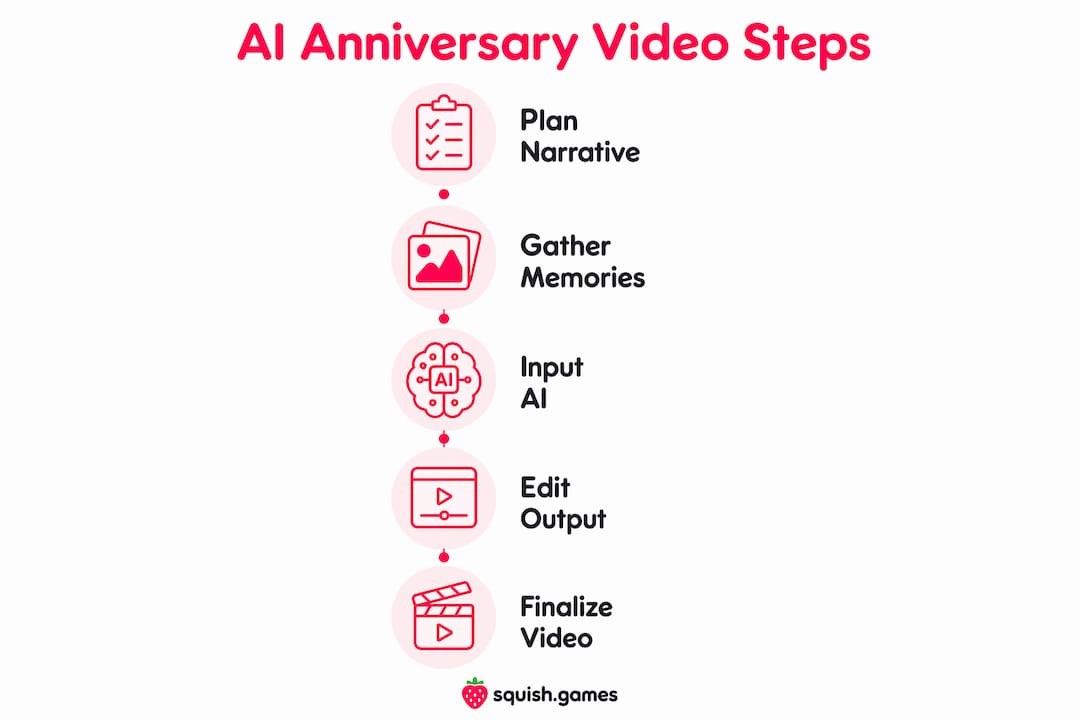
The creative process for an AI-enhanced anniversary video follows a clear sequence. Skipping steps produces generic results. Following them produces something worth keeping.
-
Collect your memories. Gather photos, short video clips, and any written notes about the occasion. Specificity matters here. A photo from a particular evening beats a generic portrait. Collected memories and themes are what make anniversary videos personal without requiring editing skills.
-
Organise your narrative arc. Arrange your materials into chapters: the beginning, the milestones, the present moment. Add a caption or text card to each chapter so the viewer understands the emotional context, not just the visual.
-
Select your theme music. Music drives emotional continuity more than any visual effect. Choose a track that matches the tone of your story, whether tender, celebratory, or playful. AI tools can now suggest or generate music based on mood prompts.
-
Apply AI enhancements. AI tools generate visuals, voiceovers, captions, and music automatically, significantly accelerating production while preserving emotional continuity. Use AI to animate still photos, apply transition effects, and generate captions that match the narrative tone.
-
Review and refine. Watch the full clip with the sound on. Check that the emotional arc holds from the first frame to the last. Adjust the generation layer settings if the visuals feel mismatched with the story.
The most common pitfall is treating the AI prompt as the entire concept. A visually impressive prompt with no narrative foundation produces a clip that looks good for three seconds and is forgotten immediately.
Pro Tip: Keep your caption text short and specific. “The night we got lost in Porto” lands harder than “A special memory.” AI caption generators work best when you give them a concrete scene to describe, not a vague emotion.
What are the benefits of AI-enhanced anniversary videos?
AI-enhanced anniversary videos offer two categories of advantage: emotional and practical. Both matter, and they reinforce each other.
On the emotional side, viewers respond more strongly to meaning and context than to editing technique. AI does not replace emotional resonance. It removes the technical friction that previously stopped people from expressing it. A well-structured AI anniversary video delivers the same emotional continuity as a professionally edited production, because the story is doing the heavy lifting.
On the practical side, AI tools lower the barrier to entry dramatically. You do not need video editing software, a timeline editor, or export settings knowledge. Upload a photo, apply an effect, add a caption, and share.
| Feature | Traditional video making | AI video concept |
|---|---|---|
| Editing skill required | High | None |
| Production time | Hours to days | Minutes |
| Personalisation depth | Limited by skill | Deep, driven by story input |
| Visual effects | Manual, technical | AI-generated from prompts |
| Emotional continuity | Dependent on editor | Built into narrative layer |
| Cost | Often high | Free to low cost |
The table above shows why the AI video concept has replaced traditional editing for personal milestone content. The creative ceiling has not dropped. The floor has simply been raised for everyone.
What AI features and trends define anniversary videos in 2026?
The most widely used AI features in anniversary videos right now cover four distinct creative functions.
- Photo animation: Still images are brought to life with bounce, dance, and movement effects. A single portrait becomes a dancing AI clip with rhythm and personality.
- AI transitions: Scene changes are generated automatically to match the mood of the narrative. The AI transition video concept replaces hard cuts with fluid, emotionally appropriate movement between memories.
- AI voiceovers: Text captions are converted into warm, natural-sounding narration without recording equipment.
- AI music generation: Mood-matched soundtracks are generated or selected based on the emotional tone of the story.
AI animated dancing clips go viral because of their emotional appeal, rhythmic movement, and engaging aesthetics. The shareability of a dancing photo is not accidental. Movement triggers attention, and attention triggers sharing.
The most significant trend in 2026 is the growth of uncensored AI art in anniversary video creation. Uncensored AI art trends reflect a move towards more personalised, expressive anniversary content. Creators are using AI-generated nude art, fantasy characters, and adult-themed imagery to produce anniversary videos that feel genuinely intimate and personal, not sanitised for a generic audience. Squish supports this directly, with NSFW and adult content available alongside its standard creative tools.
The AI souvenir video concept sits within this trend. It treats the finished clip as a digital keepsake, something designed to be saved, revisited, and shared privately rather than broadcast publicly.
Key takeaways
The anniversary video AI concept works because it separates storytelling from AI generation, placing emotional meaning first and technical effects second.
| Point | Details |
|---|---|
| Two-layer structure | Draft a narrative layer and a generation layer separately before combining them. |
| Story before prompt | Collect specific memories and milestones before writing any AI prompt. |
| AI accelerates, not replaces | AI handles visuals and music; the creator supplies the emotional meaning. |
| Uncensored AI expands options | Personalised and adult AI art gives creators more freedom in anniversary content. |
| Dancing clips drive sharing | Movement-based AI effects increase emotional engagement and social shareability. |
Why the story always wins
I have watched a lot of AI-generated anniversary content, and the pattern is consistent. The clips that land are not the ones with the most impressive visual effects. They are the ones where someone clearly sat down and thought about what they actually wanted to say.
The technology has become genuinely good. Squish can take a single photo and turn it into a bouncing, dancing, animated clip in seconds. That is not the hard part anymore. The hard part is the same as it has always been: deciding which memories matter, in what order, and why.
What I find interesting about the uncensored AI art movement within anniversary video creation is that it is not primarily about explicit content. It is about authenticity. People want anniversary videos that reflect their actual relationship, not a version of it that has been made safe for a public feed. Squish’s support for NSFW and adult content is a direct response to that demand, and it is the right call.
My honest advice: spend twice as long on your narrative layer as you do on your generation settings. The AI will handle the visuals. Only you can handle the meaning.
— Jason
Squish and AI anniversary video creation
Squish is a free-to-start AI video platform built for exactly this kind of creative work. Upload a photo, a selfie, an AI-generated character, or a fantasy image, and Squish turns it into a short animated clip with dancing effects, bouncing photo animations, or smooth transitions.
Squish requires no editing skills and works on mobile. It supports the full range of anniversary video AI concepts, from tender memory clips to uncensored adult art for private celebration. Creators can animate photos for free and explore AI effects for dancing and movement to find the right tone for their story. Whether the occasion calls for something sweet, playful, or explicitly personal, Squish has the tools to make it happen.
FAQ
What is an anniversary video AI concept?
An anniversary video AI concept is the method of combining personal memories and storytelling with AI tools to produce a personalised, emotionally engaging anniversary video. It uses two layers: a narrative layer for story structure and a generation layer for AI-driven visuals and effects.
What is an AI memory video explained simply?
An AI memory video is a short clip that collects photos, captions, and music and uses AI to animate and arrange them into a coherent emotional story. The AI handles the technical production; the creator supplies the memories and meaning.
Why do AI dancing video clips go viral?
AI dancing clips go viral because movement triggers attention and rhythmic animation creates an emotional response that static images cannot. Their short length and high shareability make them natural fits for social platforms.
What is the AI transition video concept?
The AI transition video concept uses AI to generate scene changes between memories that match the emotional tone of the narrative, replacing manual cuts with fluid, mood-appropriate movement.
What is an AI souvenir video concept?
An AI souvenir video concept treats the finished AI-generated clip as a digital keepsake, designed to be saved and revisited privately rather than shared publicly. It prioritises personal meaning over broad social appeal.
Leave a Reply