

Right now, the sounds pulling the biggest numbers are FREAKED OUT, Beat It, petal, the Mall Grab remix of Just the Way You Are, and the Remble “will he perform when he has money right in front of him” audio, alongside a handful of rising remixes and revivals. Save two or three that fit your niche, cut a rough test clip within 48 to 72 hours, and watch the completion rate before you commit to a full concept. This list refreshes roughly monthly, so bookmark it and check back rather than relying on a single scroll of your For You page.
TL;DR:
- Trending TikTok sounds in 2026 are mostly remixes and revivals of older tracks, with reveal and fail formats leading the way in engagement.
- The most popular sounds include FREAKED OUT, Beat It, petal, and the Mall Grab remix of Just the Way You Are, each suited to specific content styles.
- Creating quick, sound-synced clips with AI animations or photos using tools like Squish can outperform polished videos, especially within the first 48 hours.
- Post your content early after saving a trending sound, test its performance within two days, and adapt your niche to fit the audio format for better reach.
- Use TikTok’s native libraries, third-party trackers, and your own observations to find and leverage trending sounds before they peak or fragment into niche variations.
Table of Contents
- Tiktok trending sounds 2026: the full curated list
- How creators turn these sounds into repeatable formats
- Where to find and save trending audio before it peaks
- Why 2026 sounds trend the way they do
- Practical Squish Games use cases for trending sounds
- How TikTok’s sound algorithm actually decides what trends
- How trending sounds move the needle on reach and engagement
- Tips for actually capitalising on a trending sound
- Copyright and usage issues creators should watch for
- What creators should prioritise this week
- Turn any trending sound into a synced clip with Squish
- Sources
- FAQ
Tiktok trending sounds 2026: the full curated list
Trending audio moves fast, and “trending audio for TikTok today” rarely looks the same two weeks running. Below are the sounds carrying real momentum this cycle, based on cross-platform tracking and creator usage volume, updated as of September 2026.
FREAKED OUT has become the default choice for chaotic reveal videos, the kind where a calm setup snaps into visual absurdity on the beat drop. Use it for pet reaction clips, outfit changes, or any “before you scroll past this” hook. Post it early in the day when reaction-heavy content tends to spike engagement.
Beat It is doing double duty as both a genuine music trend and a meme carrier, appearing in dance transitions and ironic lip-sync videos. It works especially well paired with a hard cut on the chorus, so line your visual switch to the first beat of the hook.
petal has quietly become the go-to for soft, aesthetic content: slow pans, get-ready-with-me clips, and moody photo montages. It rewards patience rather than a hard punchline, which makes it a natural fit for slower-paced edits.
Just the Way You Are (Mall Grab Remix) takes the Bruno Mars original and slows it into a hazy, nostalgic house edit. Creators are using it for “then versus now” comparisons and old-photo throwbacks, since the tempo gives editors time to breathe between cuts.
The Remble “will he perform when he has money right in front of him” audio has become the standard for fail videos and comedic anticlimax, deployed over 53,000 times between mid-August and early September 2026 according to KnowYourMeme’s tracking. It’s built for the moment someone hypes themselves up and then completely fails to deliver, whether that’s a trick shot, a dance move, or a punchline.
Beyond those five, the current rotation includes several other sounds worth testing:
- A stripped-back piano remix trending for “glow up” and transformation edits, where the melody swells right as the after-shot lands.
- An Afrobeats-influenced track gaining traction for dance challenges, reflecting the genre’s growing pull on mainstream viral audio.
- A slowed R&B sample being used for caption-heavy storytelling videos, where text reveals sync to the vocal phrasing.
- A distorted rock riff popular in “villain era” or chaotic-energy edits, often layered with fast jump cuts.
- Two additional 2000s-era pop revivals resurfacing in nostalgia content, following the same slow-and-warm remix pattern as the Mall Grab track.
- A viral spoken-word clip being repurposed as background narration for list-style videos.
Buffer’s roundup of trending TikTok songs confirms a similar pattern across its own September tracking: remixes and revivals now outnumber brand-new original tracks in the weekly top charts. Several of these sounds pair unusually well with animated or AI-generated visuals, particularly the slower tracks like petal and the Mall Grab remix, where a bouncing or dancing photo effect gives the editor something visually interesting to hold on during a quieter stretch.
How creators turn these sounds into repeatable formats
Most viral clips built on trending audio for edits follow one of three structures, and you don’t need to reinvent them each time.
- Reveal or contrast: film a static setup, cut hard on the beat drop, show the payoff. Works with FREAKED OUT and Beat It.
- Slow montage: layer three to six photos or clips over a mellow track like petal or the Mall Grab remix, with one cut roughly every four seconds.
- Fail or anticlimax: hype a moment, then subvert it. This is the entire engine behind the Remble audio.
A quick template for the reveal format: film five seconds of the “before” state, add text overlay reading “wait for it,” then cut to the payoff exactly on the first strong beat after the drop. For the slow montage, keep each image on screen for three to four seconds and fade rather than hard-cut between them. For the fail format, keep the setup under three seconds. Nobody rewatches a ten-second wind-up.
Reveal and fail formats work brilliantly with static images or AI-animated stills, since the “before” moment doesn’t need real motion. Montages built for live action generally need more raw footage to feel authentic.
Pro Tip: Line your hardest visual cut to the first beat after a drop, not the drop itself. Most editors cut a fraction too early, which reads as slightly off even to viewers who couldn’t tell you why.
Where to find and save trending audio before it peaks
Finding trending audio TikTok today actually favours doesn’t require guesswork if you check the right places on a schedule.
- TikTok’s own trending sounds page and the Creative Center list official volume data and update dates, and should be your first stop each week.
- The in-app Sounds tab on any video shows exactly how many other clips use that audio, a fast gut-check for momentum.
- Scroll your own For You page for fifteen minutes and note any sound appearing three or more times. That repetition is an early signal.
- Third-party roundups such as MeetEdgar’s monthly trending audio guide cross-check what’s rising outside your personal feed.
- Music-specific playlists, like the Spotify TikTok viral playlist, help verify which commercial tracks are actually circulating versus niche audio clips.
Save anything promising into a dedicated favourites folder, tag it by format (reveal, montage, fail), and test one within two days. Waiting a week usually means the sound has already peaked.
Why 2026 sounds trend the way they do
A sound’s life follows a predictable arc: it emerges quietly, accelerates as creators copy the format, peaks for roughly one to three weeks, then fragments into niche variations before declining, a pattern TopTrends’ tracker framework lays out clearly. The clearest sign a sound still has legs is variation, seeing it show up in genuinely different video concepts rather than the same clip copied over and over.
2026 specifically leans hard into revivals and remixes rather than fresh tracks, according to Give Up Internet’s analysis of this year’s format trends, because older songs carry built-in emotional recognition while a remix keeps the tempo feeling current. Reveal formats dominate for the same reason short-form video rewards anticipation. Before you post on any sound, ask three questions: is it spreading to Instagram or YouTube Shorts too, is it still generating new video concepts, and has it been trending for under two weeks? Two “yes” answers mean it’s worth your time.
Practical Squish Games use cases for trending sounds
Pairing audio with an animated image often beats filming live footage, especially when you don’t have new content ready. Three quick examples:
- Pet reveal: an animated photo of your pet, timed so the “reveal” motion lands exactly on the beat drop of FREAKED OUT.
- Avatar dance loop: a jiggly animation set to Beat It, kept under seven seconds so it loops cleanly and holds rewatch value.
- Nostalgic montage: a set of old photos animated with a gentle bounce effect, synced to the Just the Way You Are (Mall Grab Remix) for a warm, throwback feel.
Pro Tip: Keep any looping AI clip under six to eight seconds, so viewers catch the seam and rewatch instead of scrolling past.
Always use images you own, have explicit consent to animate, or that come from licensed creator content, particularly with NSFW or adult-themed material, where consent-first use isn’t optional.
How TikTok’s sound algorithm actually decides what trends
TikTok’s recommendation system doesn’t treat audio as background noise. It treats it as a signal. When a clip using a particular sound gets high completion rates, rewatches, and shares, the platform pushes that same audio to more For You pages, not just the original video. That’s why one creator’s breakout clip can drag dozens of unrelated accounts into a trend within days.
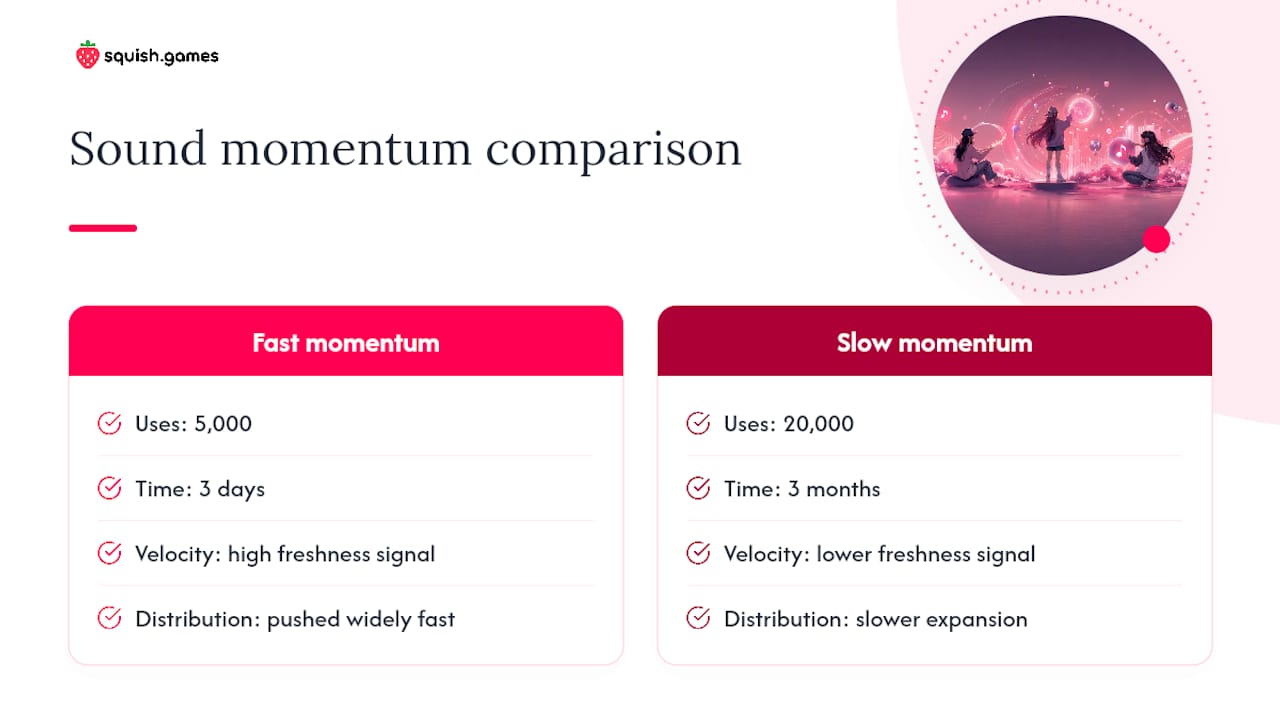
Volume matters too, but less than velocity. A sound picking up 5,000 uses in three days signals stronger momentum than one that took three months to reach 20,000. The algorithm reads that acceleration as freshness and rewards it with extra distribution.
Sound also interacts with format. TikTok appears to test a new audio clip against a small pool of viewers first, then expand distribution based on watch-through behaviour. A reveal format synced tightly to a beat drop tends to produce stronger completion numbers than a loosely edited clip using the same track, which is part of why timing your cuts matters more than picking the “right” song. Two creators can use identical audio and get wildly different reach purely because one nailed the sync point and the other didn’t.
This is also why remixes and older tracks resurface so easily. The system doesn’t distinguish between a brand-new song and a decade-old one going through a second life. It only cares whether current videos using that audio are performing well right now.
How trending sounds move the needle on reach and engagement
Using a sound that’s already gaining traction gives your video a distribution head start most original audio simply can’t match. TikTok’s system is already primed to test clips using that sound against a wider pool of viewers, so you inherit some of that momentum before your video has proven anything on its own.
The effect is strongest in the first hour after posting. A video paired with a rising sound tends to get shown to a broader initial test audience than one using silent or original audio, which means your completion rate and rewatch numbers matter even more, since a weak showing in that early window can cap your reach regardless of the audio.
Engagement patterns differ by format too. Reveal and fail clips built on trending audio tend to generate higher share rates, because the anticlimax or payoff is genuinely more satisfying to send to a friend than to simply like. Slower montage content built on tracks like petal tends to earn longer average watch time instead, which matters just as much to the algorithm but shows up differently in your analytics.
The catch is timing. Riding a sound after it’s already peaked gives you little of that discovery boost, since the algorithm has moved on to testing newer variations. That’s the real argument for checking trending lists weekly rather than monthly, and for testing a sound within a couple of days of saving it rather than letting it sit in a folder.
Tips for actually capitalising on a trending sound
Speed beats perfection here. A rough clip posted within 48 hours of spotting a rising sound will usually outperform a polished one posted a week later, once the trend has already peaked.
Match the format to the sound’s emotional register rather than forcing your usual content style onto it. A chaotic audio like FREAKED OUT doesn’t work for a calm, informational video, no matter how well-produced it is.
Don’t abandon your niche entirely. The creators who benefit most from trend content are the ones who bend a trending sound toward their existing themes rather than chasing every viral audio regardless of fit. If you make pet content, adapt the reveal format to a pet reaction rather than switching to lifestyle content just because that’s what’s trending.
Post at a time when your specific audience is active, not necessarily when the sound first started trending. Scheduling advice around timing and reach generally applies just as much to trend-based content as it does to original posts.
Finally, track your own results rather than assuming a sound will perform the same for you as it did for someone else. Save the sound, test it, check your metrics after 24 hours, and only build a bigger concept around it once you’ve confirmed it’s actually working for your specific following.
Copyright and usage issues creators should watch for
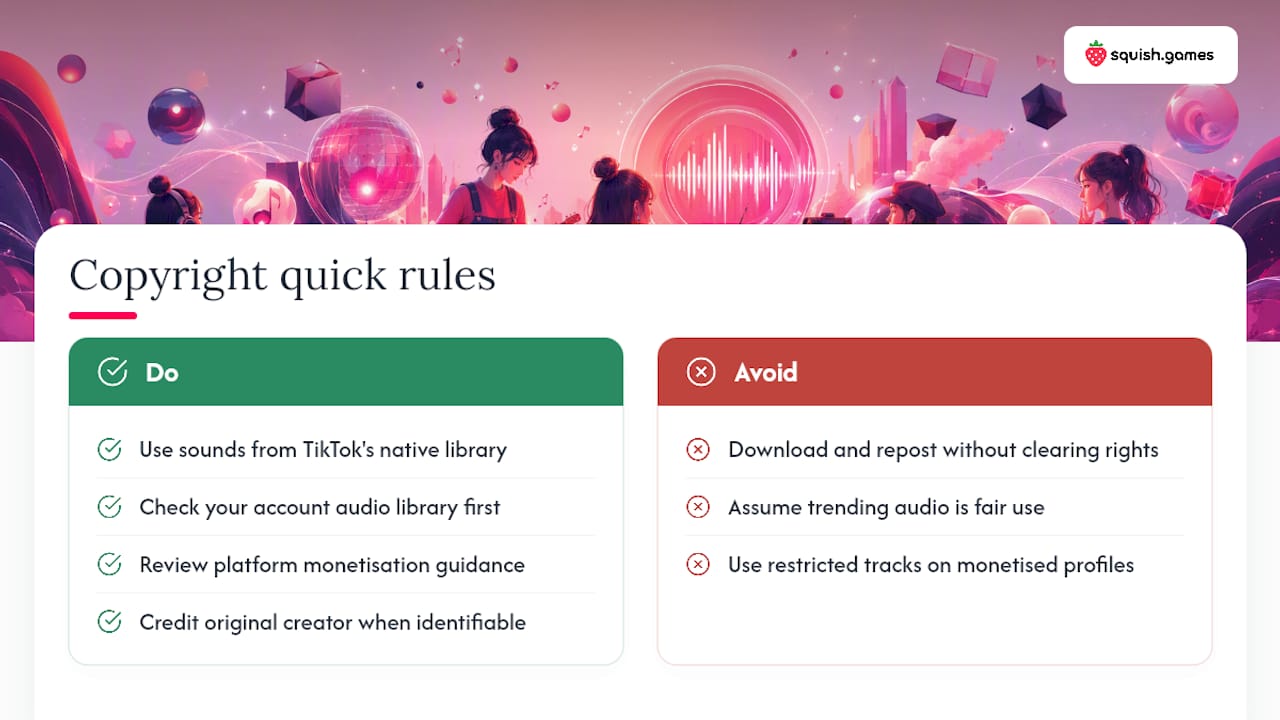
Using a trending sound inside TikTok’s own app is generally covered by licensing agreements the platform holds with major labels and distributors, which is why the built-in Sounds library exists in the first place. That protection mostly disappears the moment you download the clip and repost it elsewhere, such as Instagram Reels or YouTube Shorts, without separately clearing the rights.
Business and creator accounts face an extra wrinkle. TikTok restricts certain commercial music tracks from being used by monetised or business profiles, even when that same audio is freely available to personal accounts. If you’re running ads or promoting a product, check your account’s audio library rather than assuming a trending song is fair game, and review the platform’s own monetisation guidance before attaching commercial content to a viral track.
User-generated audio, like the Remble fail clip, generally carries fewer restrictions since it isn’t tied to a record label, but the original creator still technically owns that recording. Crediting the source when it’s identifiable is good practice, even where it isn’t strictly required.
The safest rule for anyone building a channel around trend content: use sounds through the native TikTok library rather than external rips, keep commercial use inside whatever licensing your account type permits, and treat “everyone’s using it” as a weak defence if you’re ever unsure.
What creators should prioritise this week
Chase reveal and fail formats over slow montages right now. They travel faster, and the algorithm rewards the sharp completion spikes they produce. Save two or three sounds today, test the strongest one within 48 hours, post it, then check completion rate before building anything bigger. Keep one signature format of your own running alongside trend content so your channel doesn’t disappear into the noise the moment a sound fades.
— Jason
Turn any trending sound into a synced clip with Squish
Squish is the quickest way to test a trending sound without waiting on live footage. Upload a photo, avatar, pet, or fantasy character, animate it with a bounce, dance, or jiggly effect, and time the motion to the beat drop of whichever sound is climbing this week. That’s the whole workflow: no filming, no editing skills, no waiting for a “real” video idea to show up.
It fits the exact examples covered above: a pet reveal timed to FREAKED OUT, an avatar dance loop for Beat It, or a photo montage synced to a slower revival remix. The platform supports content for creators working in a variety of spaces, including adult-themed material, always on a consent-first basis, so the same fast animation workflow applies whether the project is playful, nostalgic, or explicit. Start with the free tier and see how a single clip performs before spending anything on extra generations. For a fuller walkthrough of pairing effects with trending audio, read the guide on AI video creation with no editing skills and animate your first sound-synced clip today.
Sources
Bookmark TikTok’s trending sounds page, Buffer’s monthly roundup, and TopTrends’ cross-platform tracker, each refreshed at least monthly.
- What Is The ‘Will He Perform When He Has Money Right In Front Of Him’ Meme? — KnowYourMeme
- 13 Trending Songs on TikTok in September 2026 (+ How to Use Them) — Buffer
- Viral audio tracker: Trending sounds across TikTok, Reels and Shorts — TopTrends
FAQ
What are some trending TikTok songs in 2026?
Current standouts include FREAKED OUT, Beat It, petal, and the Mall Grab remix of Just the Way You Are, alongside several 2000s-era pop revivals resurfacing as remixes.
What are the TikTok music trends for 2026?
Remixes and revivals of older songs are outnumbering brand-new original tracks, with reveal and contrast formats dominating how creators use them.
What are current trending sounds on TikTok?
Alongside music tracks, meme-driven audio like the Remble “will he perform when he has money right in front of him” clip is trending heavily for fail and anticlimax videos.
What’s trending on TikTok in 2026?
Reveal formats, slow nostalgic montages, and fail-style clips built on remixed or meme audio, with creators increasingly pairing trending sounds with AI-animated photos or avatars using tools like Squish for quick, sound-synced content.
Leave a Reply