

Pick a tested hook formula, copy three matching micro-templates from the library below, and post them as an A/B test against your usual opening line. Land the payoff by the 1 to 3 second mark, watch your 3-second retention on each version, and keep whichever one holds viewers longer. If you want a visual-first option, Squish Games turns a photo into a moving clip in seconds, no editing required.
TL;DR:
- Writing multiple hook formulas and testing them with short videos improves early viewer retention, which is crucial for platform algorithms.
- Shorter platforms like Reels require hooks to land within approximately one second, while TikTok allows slightly more flexibility, and Shorts need clear promises early.
- Pairing visual motion, especially with AI-based tools like Squish, enhances hook effectiveness by creating engaging patterns that attract viewers.
- Testing different hook formulas on at least 12 posts helps identify the most effective approach, using metrics like three-second retention and 48-hour reach for decision-making.
- Burying the hook promise in the first seconds or overloading it with ideas harms engagement; focus on delivering a clear, succinct message aligned with content type.
Table of Contents
- What are the best hooks for short videos?
- Why do certain hook formulas work better than others?
- How do you time hooks for TikTok, Reels and Shorts?
- How do you A/B test video hooks properly?
- A note from Jason at Squish Games
- What mistakes ruin an otherwise good hook?
- How does music or sound improve a video hook?
- Do hooks need to change for tutorials, stories or promos?
- What most guides get wrong about hooks
- How Squish turns a photo into a hook in seconds
- Sources
- FAQ
What are the best hooks for short videos?
The best short video hooks are copy-and-adapt lines, not blank-page ideas. Below are working micro-templates grouped by formula, with notes on how to pair each one with a visual pattern interrupt so the words and the image do the work together.
Curiosity gap hooks create a question the viewer needs answered before they can look away.
- “Nobody tells you this about [topic] until it’s too late.”
- “I tried [thing] for 30 days and the results weren’t what I expected.”
- “This is the part of [process] nobody shows you.”
Bold claim hooks state something contrarian or oversized in the first breath.
- “This is the worst advice in [niche] and everyone still repeats it.”
- “You’ve been doing [common task] wrong your whole life.”
- “This costs £0 and works better than the £200 version.”
Number hooks promise a countable, skimmable payoff.
- “3 things I wish I knew before starting [activity].”
- “5 seconds. That’s all it takes to fix [problem].”
- “1 mistake ruins 90% of [niche] attempts.”
POV hooks put the viewer inside a specific identity or moment.
- “POV: you just found out [surprising fact].”
- “POV: your first week doing [job/hobby] as a beginner.”
- “POV: the moment you realise [relatable revelation].”
Reveal tease hooks withhold the outcome and promise it’s coming.
- “Watch what happens when I [action] for the first time.”
- “Wait for the transformation at the end.”
- “I didn’t believe this would work until I saw the result.”
Relatable observation hooks open with a shared, specific frustration or habit.
- “Why does everyone in [niche] do this exact same thing?”
- “The way we all pretend to understand [topic] but don’t.”
- “Tell me you’re a [role] without telling me you’re a [role].”
For entertainment content, POV and reveal tease formulas outperform because viewers are there for a payoff moment, not information. Fitness and finance content does better with bold claims and numbers. Lifestyle creators tend to get more mileage from POV and relatable observation lines because the audience is watching to see themselves reflected, a pattern QuSO’s hook research backs up with platform-level data.
Whichever line you pick, pair it with a visual cue in the first frame. A quick zoom, a caption overlay, or a striking first frame all reinforce the spoken or written hook rather than compete with it, an approach MediaDrop’s breakdown of viral hook formulas covers in more depth. If your first frame is a still photo, running it through something like Squish’s playful video effects before you post gives that opening frame motion instead of a static image, which is often the difference between a scroll-past and a stop.
Why do certain hook formulas work better than others?
Each formula exploits a different psychological trigger, and knowing which one you’re pulling helps you pick the right tool for your niche rather than guessing.
- Curiosity gap: creates an information void the brain wants closed.
- Bold claim: triggers disbelief or mild outrage, both of which slow the scroll.
- Story opener: taps narrative instinct, viewers stay to see how it ends.
- Problem hook: names a pain point the viewer already has, so it feels personal.
- Number hook: signals structure and a defined time cost, lowering the barrier to watch.
- POV/identity: creates in-group recognition, “this is about me specifically.”
- Reveal tease: builds suspense by withholding the payoff.
- Relatable observation: builds social connection through shared experience.
None of this matters if the opening doesn’t survive the first three seconds. That window is the single biggest predictor of whether a platform’s algorithm keeps pushing your clip to new viewers, which is why MediaDrop’s formula framework treats those first seconds as the whole game, not just the introduction to it.
Early retention is the real currency. Pro creators increasingly test the same clip with two different openings and judge success purely on 3-second retention, not likes or comments, according to Contra’s A/B testing guide for Reels.
Visual and spoken hooks aren’t either/or. A striking first frame combined with a short caption overlay tends to outperform either element alone, since the eye and the ear are reinforcing the same promise instead of splitting the viewer’s attention.
How do you time hooks for TikTok, Reels and Shorts?
The formula can stay the same across platforms, but the delivery window shrinks or stretches depending on where you post.
- Instagram Reels: the tightest window of the three. Motion needs to start by roughly 1.0 second, with the payoff landing by 3.0 seconds, according to UGC Copilot’s Reels-specific hook benchmarks.
- TikTok: slightly more forgiving. Raw, unpolished POV delivery often beats a heavily produced open, since the platform’s culture rewards authenticity over polish.
- YouTube Shorts: viewers expect a clear promise stated early, closer to a mini-headline than a tease.
Porting a hook from TikTok to Reels usually means trimming 0.5 to 1.0 second of setup, since Reels’ stricter early window punishes any wasted first frame that TikTok would tolerate.
Pro Tip: Film your hook twice: once with a slower TikTok-style build, once with the first half-second cut clean for Reels. Post both versions and let the retention numbers tell you which platform’s audience prefers which cut.
How do you A/B test video hooks properly?
- Write one body script and film 4 to 6 different openings for it, keeping everything after the hook identical.
- Post one variant per slot across your normal posting schedule, never two variants on the same day to the same audience.
- Check 3-second retention and completion rate after each post, then hold your full judgement for 48 hours, since early metrics settle within that window.
- Log results in a simple sheet: hook formula, retention, completion rate, 48-hour reach.
- Kill any hook that scores below your account’s average retention after two posts, keep testing the ones that beat it.
| Metric | What it tells you | Decision rule |
|---|---|---|
| 3-second retention | Whether the hook stopped the scroll | Below account average = cut it |
| Completion rate | Whether the whole video holds attention | Low completion with high retention = fix the middle, not the hook |
| 48-hour reach | Whether the platform is pushing the clip further | Flat reach after 48 hours = the algorithm has decided |
Run this across a 12-post block, testing three formulas four times each, and you’ll have a genuinely reliable answer for your account, not a guess borrowed from someone else’s niche. Contra’s testing framework uses roughly this structure and it holds up across most content types.
A note from Jason at Squish Games
I pair a 5 to 10 second Squish clip with a caption hook rather than a spoken one; it lets the motion carry the curiosity gap while the text does the specifics. If you’re stuck for visuals, Squish’s guide to AI clips and follower growth is a decent starting point, and pairing captions properly matters just as much as the clip itself.
What mistakes ruin an otherwise good hook?
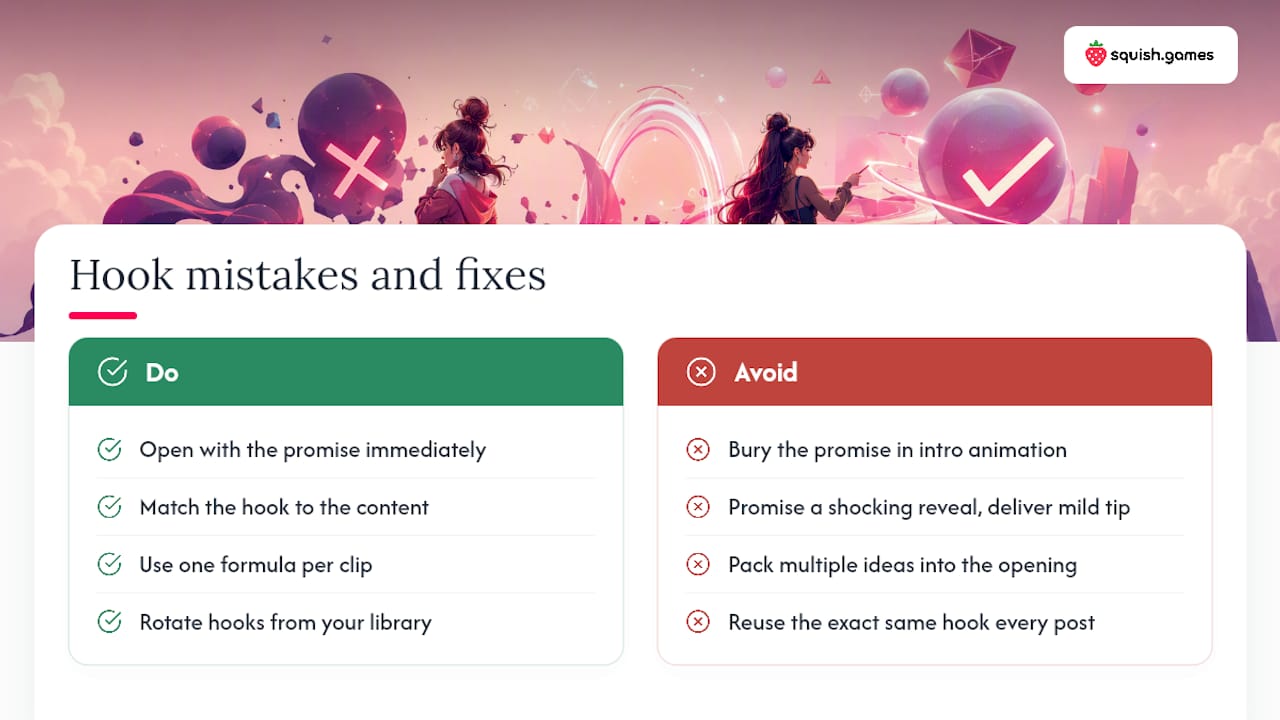
The most common mistake is burying the promise. Creators spend the first two seconds on a logo animation, a slow zoom, or a “hey guys” greeting, and by the time the actual hook lands, the algorithm has already logged a scroll-past. Cut the throat-clearing entirely.
The second mistake is mismatching the hook to the content. Promising a “shocking reveal” and then delivering a mild tip breaks trust fast, and viewers who feel baited rarely finish the video or come back for the next one.
Overloading the hook with too many ideas is another common trap. Trying to pack a curiosity gap, a number, and a bold claim into one opening line usually dilutes all three. Pick one formula per clip and commit to it.
Reusing the exact same hook across every post is a subtler problem. It works for a while, then audiences pattern-match it and start scrolling past before the line even finishes. Rotate through your library rather than leaning on one favourite.
Finally, plenty of creators test hooks against the wrong metric, chasing likes or comments instead of 3-second retention. Likes are a lagging signal; retention in the opening seconds is what actually decides whether the platform keeps distributing the clip.
How does music or sound improve a video hook?
Sound is doing more work than most creators credit it for. A hook delivered over silence, or worse, mismatched audio, loses momentum even when the words are strong. Matching the beat drop or a sharp sound effect to the exact moment your visual payoff lands amplifies the reveal, since the ear registers the emphasis a split second before the brain processes the image.
Trending audio carries its own discovery advantage independent of your hook’s quality, since some platforms surface clips using popular sounds to viewers who follow that audio trend. That said, trending sound never rescues a weak hook. It boosts an already strong opening; it doesn’t fix a buried one.
For voiceover-led hooks, a short pause of silence right before the punchline can outperform constant background music, because the pause itself signals “something’s coming” to the viewer’s attention. For visual-only hooks, a sharp cut on the beat does similar work.
If you’re animating a still image into a hook clip, syncing the motion (a jiggle, a bounce, a spin) to a beat rather than letting it play arbitrarily makes the visual pattern interrupt land harder. A tool like Squish can time simple motion effects to a clip’s rhythm without any manual editing, which is worth testing if your current hooks feel visually flat against strong audio.

Do hooks need to change for tutorials, stories or promos?
Yes, and treating every video type with the same hook style is a common reason retention drops on certain formats even when the creator’s usual content performs well.
Tutorials need a problem hook or number hook up front, stating exactly what the viewer will walk away knowing. “3 things I wish I knew before [skill]” works because it sets a concrete, finite expectation.
Story-driven clips lean on reveal tease or curiosity gap formulas, since the entire point is withholding an outcome the viewer wants. Opening a story with the ending defeats the format, so the hook should promise a destination without naming it.
Promotional clips need the most restraint. A hard sales pitch as the opening line is the fastest way to trigger a scroll-past, so bold claim or relatable observation hooks tend to outperform anything that sounds like an advert. Lead with the problem the product solves, not the product.
Matching the hook formula to the content type isn’t a stylistic nicety, it’s the difference between a viewer who trusts what happens next and one who assumes they already know and moves on.
What most guides get wrong about hooks
Most advice treats the hook as a writing problem. It’s actually a testing problem. A clever line means nothing until it’s been run against your specific audience across enough posts to separate signal from noise, and that’s where most creators stop short, they write one hook, post it once, and move on regardless of how it performed.
The conventional wisdom oversells originality and undersells repetition with variation. You don’t need a new hook idea every single day, you need the same eight or so formulas rotated and measured relentlessly, with the losers cut and the winners refined. Retention data, not gut feeling, should decide which formula becomes your default.
What I’d prioritise first: pick three formulas that suit your niche, write three hooks each, and run the 12-post test before touching anything else. Visuals matter enormously too, and pairing a strong opening line with a moving image rather than a static photo is one of the simplest upgrades available, particularly for anyone whose current content is just static images explained as playful video rather than genuinely animated.
— Jason
How Squish turns a photo into a hook in seconds
Some AI platforms provide a visual hook option when you don’t have footage, don’t want to film, or just need a reveal-style clip to pair with a bold claim line. Users can upload selfies, AI-generated characters, pet photos, or fantasy art to create short moving clips, dancing images, or jiggly animations, often free to start and with no editing skills required.
Three workflows worth trying: animate a selfie into a subtle bounce for a POV hook, build a full reveal tease by animating a before-and-after image pair, or create a dancing avatar clip to use as a visual pattern interrupt against a static-heavy feed. Some platforms also support NSFW and adult-themed content for creators working in that space, alongside standard social-ready clips, so the same platform covers everyday hook content and more explicit creative work under one consent-first upload process.
Start with the primary Squish creator guide to see the full range of effects, then test a Squish clip against your current static hook in your next 12-post batch. If the retention numbers move, you’ve found your next default opener.
Sources
- Ab‑test your way to viral: a guide to experimenting with Reels | Contra
- How to create viral hooks for short videos: 40+ examples and formulas (MediaDrop blog)
- Quso
- 12 viral hooks for Instagram Reels (UGC Copilot)
FAQ
What are some good hooks for videos?
Curiosity gap lines (“Nobody tells you this about…”), bold claims, number hooks (“3 things I wish I knew…”), and POV openers all perform consistently well; the right one depends on your niche and content type.
What is a hook in a short video?
A hook is the opening line, frame, or sound in the first 1 to 3 seconds designed to stop a viewer scrolling and commit to watching the rest of the clip.
What are some good hook examples?
“POV: you just found out [surprising fact],” “3 things I wish I knew before [activity],” and “Watch what happens when I [action] for the first time” are all working templates across entertainment, fitness, and lifestyle content.
What are good YouTube Shorts hook ideas?
Shorts audiences respond well to a clear, stated promise early, such as a number hook or problem hook, since the format rewards a defined payoff over an open-ended tease.
Can AI tools help create video hooks?
Yes. Generators like QuSO’s hook tool produce platform-tuned variants quickly, and a photo-to-video platform such as Squish can turn a still image into a moving visual hook without any editing skill required.
Leave a Reply