

The TAKE IT DOWN Act now sets the federal floor: it criminalises publishing non-consensual intimate deepfakes and forces platforms to pull them down within 48 hours of a valid notice. States build on top of that floor unevenly. Some criminalise the creation of a fake intimate image even if it’s never shared; others only punish distribution, and a handful add private lawsuits or political-ad disclosure rules the federal law doesn’t touch.
TL;DR:
- Federal law criminalizes knowingly publishing non-consensual intimate deepfakes and requires platforms to remove reported content within 48 hours, with strict liability thresholds.
- State laws vary widely, with some criminalizing creation or possession of deepfake images, and others focusing solely on dissemination or civil remedies, creating a fragmented legal landscape.
- Platforms must establish a clear, accessible notice-and-removal process before May 19, 2026, or risk enforcement action from the FTC, including documenting all requests and removals.
- Civil liability options differ by state, with some allowing damages and others imposing strict platform liability, while federal law offers limited criminal penalties and no nationwide civil cause of action yet.
- Law enforcement use of deepfake technology remains legally ambiguous, with no specific federal restrictions, but existing rules on undercover investigation and evidence apply for internal or investigative purposes.
Table of Contents
- What does the federal deepfake law actually say?
- How much do state deepfake laws actually vary?
- What must platforms do, and how does the FTC enforce it?
- What can victims actually sue for or press charges over?
- How do I report a deepfake and get it removed?
- What legal defences and constitutional limits apply?
- How can creators build consent into their workflow?
- Why do federal and state deepfake laws sometimes conflict?
- Which court cases have shaped deepfake law so far?
- Can law enforcement use deepfake technology itself?
- What does this mean for privacy and data protection?
- The line between fun and harm isn’t always obvious
- Want to animate photos the fun, consent-first way?
- Sources
- FAQ
What does the federal deepfake law actually say?
Congress signed the TAKE IT DOWN Act, formally Public Law 119–12, on May 19, 2025. It’s the first federal statute to directly criminalise non-consensual intimate imagery generated or altered by AI, and it does two distinct jobs: it creates new federal crimes, and it imposes a takedown duty on platforms that host user content.
The statute defines an “intimate visual depiction” broadly enough to cover authentic photos, altered images, and fully synthetic ones. A “digital forgery” is the law’s term for AI-generated or AI-manipulated content that convincingly depicts a real person in an intimate context they never consented to. An “identifiable individual” doesn’t require a full face shot. Distinctive tattoos, a recognisable setting, or corroborating context can be enough, which matters enormously for evidence: prosecutors don’t need a clean face match if other identifying details tie the image to a real person.
The core offences criminalise knowingly publishing, or threatening to publish, a non-consensual intimate image, real or digitally forged, of an identifiable adult without consent. A related provision covers minors under stricter terms.
Penalties scale with the victim’s age and the offender’s intent:
- Federal prison penalties for offences involving adult victims can include imprisonment.
- Offences involving minors carry stricter penalties under federal law.
- Enhanced penalties apply where there’s a pattern of conduct or intent to harass, intimidate, or profit from the images.
The CRS legal analysis of the Act breaks its provisions into two buckets: the new criminal prohibitions under a revised section 223, and a separate notice-and-removal regime enforced by the Federal Trade Commission (FTC) rather than the Department of Justice. That split matters. Criminal liability targets the person who made or shared the image. The removal duty targets the platform that hosts it, regardless of who’s at fault for the original posting.
A covered platform, generally a website, app, or service that primarily hosts user-generated content and has a meaningful user base, must stand up a process letting a victim (or their representative) submit a written request identifying the content and asserting, in good faith, that it depicts them without consent. Once that request lands, the clock starts: the platform must remove the content as soon as possible, with a statutory maximum removal time frame. Platforms acting in good faith on a facially valid request get liability protection even if the removal turns out to be a mistake, which is meant to stop platforms from sitting on requests out of fear of being sued by the uploader.
The compliance deadline for covered platforms to have this process fully operational is May 19, 2026, one year to the day after enactment. Platforms that ignore the requirement, or build a removal process in name only, risk FTC enforcement action, which is covered in more depth further down.
How much do state deepfake laws actually vary?
Federal law sets a national minimum. States decide how far past it to go, and the differences are not cosmetic. A scholarly review of 319 state bills introduced between 2019 and 2024 found 135 bills targeting sexually explicit deepfakes and 126 targeting political deepfakes, evidence of a genuinely fragmented legislative patchwork rather than a single coherent policy.
Three broad patterns show up across the states:
- Creation and possession offences. Some states criminalise generating a synthetic intimate image of a real person without consent, whether or not it’s ever published. Simply having it on a device can trigger liability.
- Dissemination and publication offences. Other states only reach the act of sharing or distributing the image, leaving pure creation in a legal grey zone.
- Political disclosure laws. A separate category requires prominent labelling of AI-altered content in campaign ads, rather than banning the content outright.
Legal commentary comparing state approaches points to Florida and Texas as states that reach creation or possession of sexual deepfakes directly, while New York and California lean more on statutory civil remedies, giving victims a clearer path to sue for damages alongside whatever criminal charges apply.
Minnesota stands out for a different reason. Minnesota HF 1606 doesn’t just target the person who made the image, it imposes strict civil liability on the platform that hosted it, a materially tougher standard than the federal “good faith removal” shield. Whether that model survives court challenges on preemption and First Amendment grounds will likely shape whether other states copy it or back away from strict platform liability altogether.
| State pattern | What it reaches | Example jurisdictions |
|---|---|---|
| Creation/possession offence | Generating or holding a synthetic intimate image, published or not | Florida, Texas |
| Publication/dissemination offence | Sharing or distributing the image | Varies; many states limit liability to this stage |
| Civil remedy statute | Lets victims sue for damages independent of criminal charges | New York, California |
| Platform strict liability | Holds the hosting platform civilly liable, not just the uploader | Minnesota (HF 1606) |
The state and federal tracker maintained by StackCyber puts the count of states addressing sexually explicit deepfakes at roughly 48, though the exact tally shifts as legislative sessions close and new bills are signed. If you’re checking your own state’s status, a live tracker beats any static list. Laws are moving fast enough that a guide written six months ago can already be out of date on a specific state’s rules.
What must platforms do, and how does the FTC enforce it?
A covered platform under the TAKE IT DOWN Act is generally one that hosts user-generated content at meaningful scale. Small forums with negligible traffic, or services that don’t host user uploads at all, typically fall outside scope, though the exact line depends on how a platform’s user base and content model are structured.
A compliant notice page needs a few concrete things: a clear description of what counts as a covered image, a simple submission form asking for the URL or location of the content, a good-faith statement that the depiction is non-consensual, and contact information for the requester. Vague or buried reporting links, the kind you have to hunt for through three menus, invite regulatory scrutiny even if they technically exist.
Enforcement runs through the FTC rather than criminal courts. The tracker on FTC posture notes the agency has already sent warning letters to major platforms ahead of the compliance deadline, and treats a failure to build a working notice-and-removal system as a potential unfair or deceptive acts or practices (UDAP) violation under the FTC Act. That framing gives the FTC civil penalty authority without needing a new enforcement statute; it’s using powers it already has.
- Confirm your platform meets the “covered platform” threshold under the statute’s own criteria.
- Build a notice page with all four required elements before May 19, 2026.
- Train moderation staff on the 48-hour clock, not a “best effort” internal target.
- Log every removal request and action taken, since FTC scrutiny will focus on documented process, not intentions.
Pro Tip: If you run any platform that lets people upload photos or video, even a niche hobby app, don’t assume you’re too small to be “covered.” Build the notice-and-removal page now rather than waiting to find out the hard way.
What can victims actually sue for or press charges over?
Federal criminal penalties top out at two years’ imprisonment for offences against adults and three years where the victim is a minor, with enhancements for repeat conduct or profit motive. States layer their own criminal penalties on top, and they vary widely: some cap out lower than the federal maximum, others allow felony charges that exceed it depending on aggravating factors like distribution to minors or use in extortion.
Civil remedies are where the real variation shows up. States with private causes of action, New York and California among them per comparative legal commentary, let victims sue independently of any criminal case. Available remedies typically include:
- Statutory damages that don’t require proving a specific dollar loss.
- Injunctive relief ordering removal or barring further distribution.
- Restitution tied to a criminal conviction, covering therapy costs, lost wages, or reputational harm.
- Attorney’s fees in some state statutes, which lowers the barrier to actually filing.
A proposed federal civil remedy, the DEFIANCE Act, would add a nationwide cause of action so victims aren’t dependent on their state having passed one. It hasn’t been enacted, so right now your civil options still depend heavily on where you live.
Timing matters more than most victims realise. Evidence degrades fast: platforms may purge content and logs, and screenshots without metadata carry less weight in court. File both the platform notice and any civil claim as early as possible, ideally before evidence disappears rather than after.
How do I report a deepfake and get it removed?
Move fast and document everything before you request removal, not after.
- Save the evidence first. Capture full URLs, timestamped screenshots, the file itself if you can access it, and any direct messages or comments referencing it.
- Identify the platform’s notice process. Covered platforms must publish one under the TAKE IT DOWN Act; look for a dedicated reporting form rather than a generic contact page.
- Submit the request with a good-faith statement. Most compliant forms ask for your identifying information, the content’s location, and a signed statement that the depiction is non-consensual, mirroring language drawn from the statute itself.
- Track the clock. A covered platform has 48 hours to act once your request is validly submitted.
- Escalate where needed. If the platform ignores or stonewalls your request, file a complaint with the FTC, contact local police for a possible criminal charge, or speak with a civil attorney about a state-law claim.
Pro Tip: Screenshot the platform’s own reporting page alongside the offending content. If a platform later claims it never received a valid notice, proof that the form existed and what it required is worth more than your memory of filling it out.
What legal defences and constitutional limits apply?
The CRS analysis flags First Amendment tension as the Act’s biggest open legal question: content regulation, even of harmful synthetic imagery, invites scrutiny over whether the law is narrowly tailored or sweeps in protected speech.
That tension is sharpest around political deepfakes. Courts reviewing state election-disclosure laws have shown willingness to enjoin ones drafted too broadly, particularly where they risk catching satire, parody, or private commentary alongside genuine deceptive political ads. Narrowly tailored disclosure rules, requiring a label rather than banning the content, tend to survive challenge better than outright bans.
Common defences raised by creators or platforms include:
- Newsworthiness or public interest, arguable where the content relates to a public figure and matters of legitimate public concern.
- Consent to creation, though this rarely covers publication; consenting to have an image made is legally distinct from consenting to have it shared.
- Lack of identifiability, arguing the depicted person can’t reasonably be recognised.
Cross-state jurisdiction adds another wrinkle: a creator in one state, a victim in another, and a platform headquartered in a third can all trigger different governing law. Section 230’s platform immunity generally still shields hosts from liability for user-generated content, but the TAKE IT DOWN Act’s removal duty operates alongside that immunity rather than replacing it, so a platform can still face FTC action for failing to remove content even where Section 230 would bar a private lawsuit against it.
How can creators build consent into their workflow?
Legal compliance and good creative practice point the same direction here: get consent before you generate, not after someone complains. A five-step consent workflow gives creators a practical way to meet the spirit of the law, not just the letter of it.
- Get affirmative, specific consent for the exact use case, not a blanket sign-off for anything.
- Make consent revocable, so a subject can withdraw permission and have content removed.
- Keep dated records of that consent alongside the content itself.
- Tag files with takedown-ready metadata so a removal request can be actioned in minutes, not hours.
- Publish a plain-language notice page so anyone depicted knows exactly how to reach you.
Squish’s own step-by-step consent workflow for creators walks through affirmative and revocable consent in more detail, and its NSFW content moderation guidance covers how creators should handle adult content responsibly under current platform rules.
Why do federal and state deepfake laws sometimes conflict?
Federal law sets a floor, not a ceiling, which is precisely where the friction starts. The TAKE IT DOWN Act’s 48-hour removal duty and its criminal provisions apply nationwide, but nothing stops a state from imposing tougher standards, and several already have.
Minnesota’s platform strict-liability model is the clearest flashpoint. Federal law gives platforms a good-faith safe harbour for removal decisions; Minnesota’s approach exposes platforms to civil liability regardless of good faith. That’s a genuine legal collision, and it raises a preemption question: does the federal statute’s more permissive framework override the state’s stricter one, or can states legitimately impose extra duties the federal law doesn’t forbid?
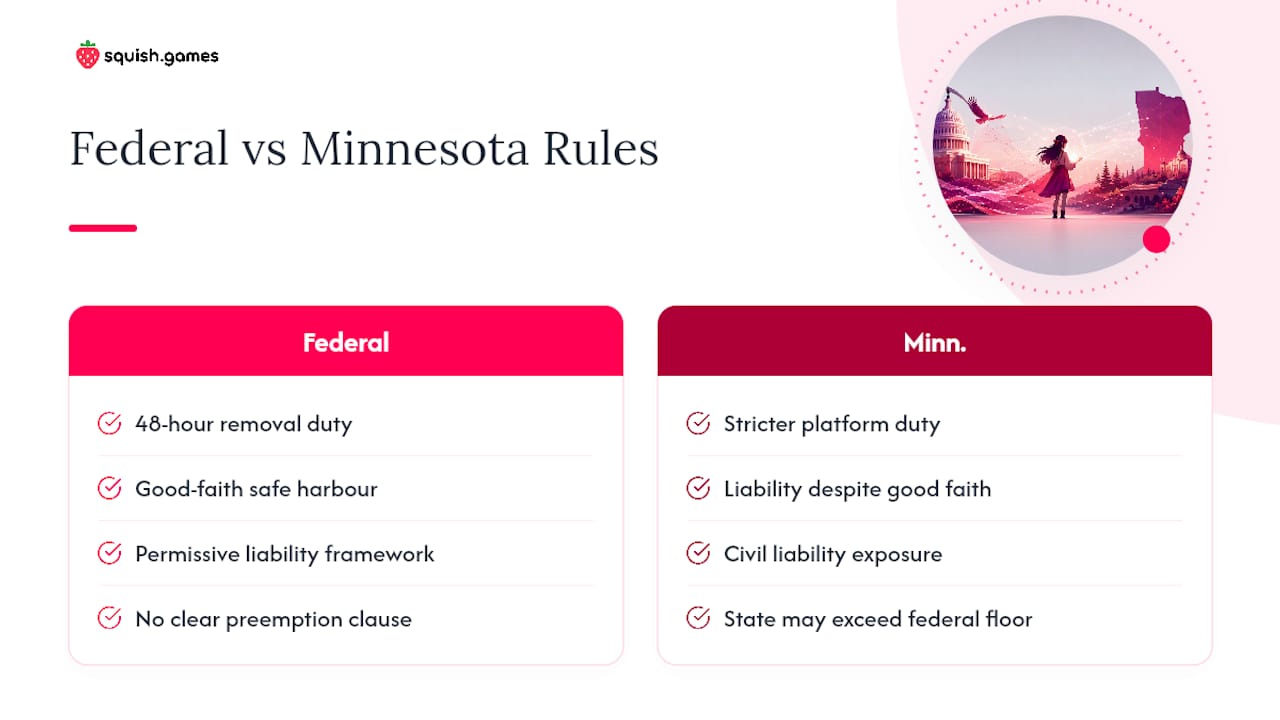
There’s no settled answer yet. Federal law generally preempts state law only where Congress explicitly says so or where compliance with both is impossible, and the TAKE IT DOWN Act doesn’t contain a clear preemption clause covering platform liability. That ambiguity means state experiments like Minnesota’s are likely to be tested in court before anyone knows whether they can coexist with the federal scheme.
Practically, this leaves platforms operating everywhere, and creators posting from anywhere, needing to satisfy the strictest applicable state rule as well as the federal floor. A one-size-fits-all national compliance policy that only meets the federal minimum won’t necessarily protect a platform from liability in a state that has gone further.
Which court cases have shaped deepfake law so far?
Deepfake law is young enough that there’s no landmark Supreme Court ruling defining its outer limits yet, but a body of lower-court activity is already shaping how the rules get applied.
Litigation around state election-disclosure statutes has produced some of the clearest signals. Courts asked to block overly broad political deepfake disclosure laws have generally sided with plaintiffs where a statute risked sweeping in satire, parody, or ordinary political commentary alongside genuinely deceptive synthetic media. The pattern that’s emerged favours laws requiring a label over laws imposing an outright ban, since disclosure requirements are viewed as a lighter First Amendment burden than content bans.
Minnesota’s HF 1606 is the platform-liability case to watch going forward. Because it departs from the federal good-faith safe harbour by exposing platforms to strict civil liability, legal trackers monitoring the law expect challenges on both preemption and First Amendment grounds. How that litigation resolves will likely determine whether other states copy Minnesota’s tougher model or retreat to holding individual creators liable while leaving platforms with the federal safe harbour intact.
Expect this area to move quickly over the next couple of years. With the federal compliance deadline landing in May 2026 and multiple state laws still working through their first real enforcement actions, the current body of case law is a starting point, not a settled body of precedent.
Can law enforcement use deepfake technology itself?
The laws discussed so far target private citizens and platforms, but a separate question keeps coming up: what about police using synthetic media themselves?
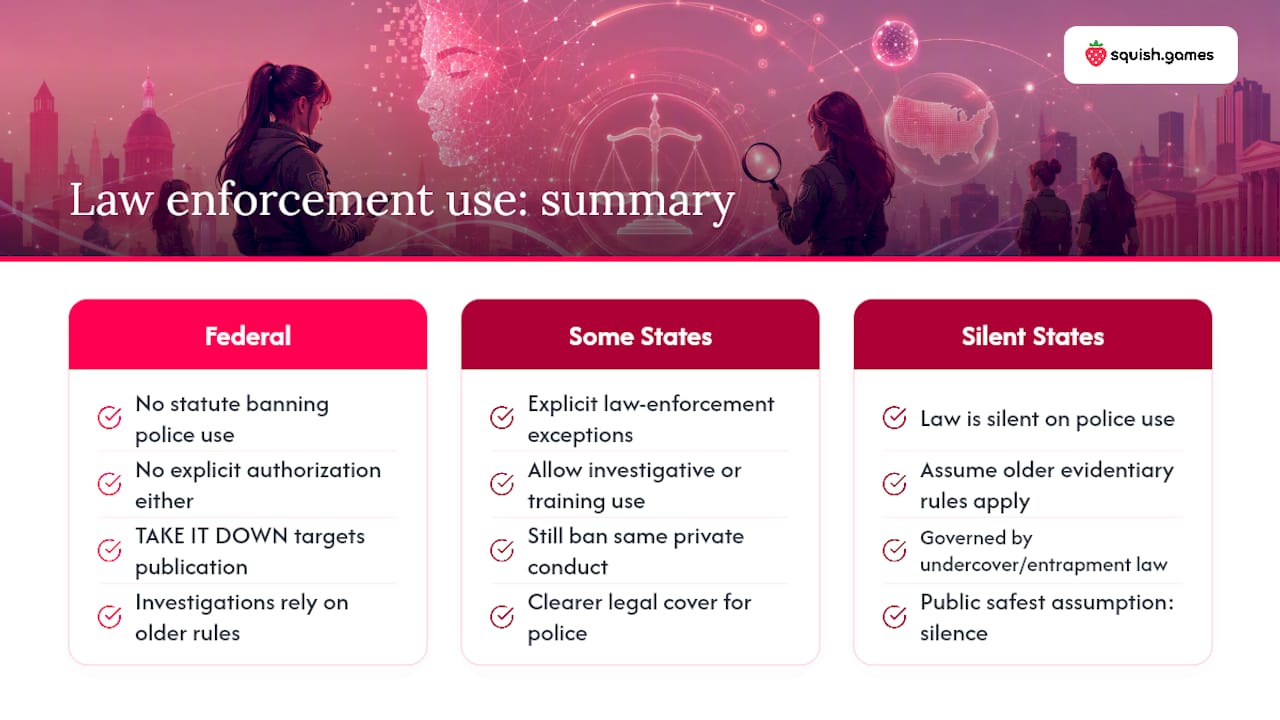
There’s no federal statute specifically banning law enforcement from using AI-generated or altered imagery in an investigation, which leaves a genuine grey area. Using a synthetic image or voice clone as an investigative tool, say, to test a witness’s reaction or build an undercover persona, isn’t clearly addressed by the TAKE IT DOWN Act, which is written around non-consensual publication rather than investigative use.
That gap matters because it cuts both ways. Nothing in current federal law explicitly authorises deceptive law enforcement use of deepfakes either, so any such practice would fall back on existing rules governing undercover investigations, entrapment, and evidentiary admissibility, rules written long before generative AI existed. A synthetic image used to build a criminal case would also face scrutiny in court over chain of custody and authenticity in a way that traditional photographic evidence generally doesn’t.
Some state legislation aimed at deepfakes carves out explicit law enforcement exceptions, allowing use for legitimate investigative or training purposes while still banning the same conduct by a private citizen. Where a state’s law is silent on this point, the safest assumption for the public is that law enforcement’s use of the technology is governed by older evidentiary and constitutional rules rather than the newer deepfake-specific statutes.
What does this mean for privacy and data protection?
Deepfake law and privacy law overlap more than most people realise, because generating a convincing synthetic image of someone typically requires their existing photos, video, or biometric data in the first place.
That overlap raises a question the TAKE IT DOWN Act doesn’t really answer: who’s liable for the underlying data used to train or prompt the forgery? If a deepfake is built from images scraped without consent, the harm arguably starts well before publication, at the point of data collection. Federal privacy law doesn’t currently have a single comprehensive statute addressing this the way the EU’s GDPR does, which means claims here often depend on a patchwork of state privacy laws, some of which give residents rights to know what data companies hold and to demand its deletion.
The AAP’s policy summary draws out a distinction worth repeating: consenting to have a photo taken is not the same as consenting to have that photo, or biometric data drawn from it, used to generate something else entirely. That gap between original consent and downstream use is exactly where a lot of real-world harm happens, and it’s a gap that current federal law addresses through the publication stage, not the data-collection stage.
The line between fun and harm isn’t always obvious
The technology behind a dancing photo effect and the technology behind a non-consensual deepfake is often the same underlying model. What separates a fun creative platform from a legal liability is entirely about consent, not capability. Anyone building or using AI image tools needs to internalise that distinction now, because state legislatures clearly aren’t waiting for the industry to sort it out on its own.
The most useful thing a creator can do isn’t legal research, it’s building consent into the workflow from the start and keeping a paper trail. Screenshots, timestamps, and signed permissions sound tedious until you’re the one trying to prove you did things right.
— Jason
Want to animate photos the fun, consent-first way?
If everything above sounds like a minefield, here’s the more relaxed version: Squish is built so you never have to guess where the line is. It is possible to turn a selfie, an AI-generated character, a pet photo, or a licensed creator image into a short, playful video, a bouncing photo effect, or a jiggly animated clip with adult and NSFW options for consenting adult uploads, using a platform designed around a consent-first structure.

You skip the guesswork about what’s appropriate because the platform is built around affirmative, revocable consent from the start, not bolted on after a complaint. Whether you’re an influencer looking for a fast selfie-to-video workflow or a digital artist experimenting with animated art for the first time, some platforms give a straightforward path to move photos and images into short-form video without touching an editing timeline using the secret AI hack smart marketers are using to create viral videos in minutes. Start with the complete 2026 guide to AI video creation with no editing skills to see exactly how the process works, and get your first animation moving today.
This article is general information, not a substitute for advice from a qualified lawyer. Consult a qualified legal professional about your own circumstances before acting on anything here.
Sources
- Public Law 119–12 (TAKE IT DOWN Act)
- Deepfake legislation tracker: federal, state laws (StackCyber)
- AI deepfake porn laws expand across the U.S., but states differ on what is illegal (Law Commentary)
- Laws and policies around AI‑generated deepfakes & pornography (American Academy of Pediatrics)
FAQ
What states are deepfakes illegal in?
Roughly 48 states now address sexually explicit deepfakes in some form, according to state legislative trackers, though the exact list shifts as new bills pass; check a live tracker for your specific state rather than relying on a static count.
Is there a law for deepfakes?
Yes. The federal TAKE IT DOWN Act criminalises non-consensual publication of intimate deepfakes and requires covered platforms to remove reported content within 48 hours, and most states layer their own criminal or civil rules on top.
Can you sue someone for a deepfake?
In states with a private cause of action, including New York and California, victims can sue independently of any criminal case for damages, injunctions, or restitution; the proposed federal DEFIANCE Act would extend that right nationwide if enacted.
Are deepfakes illegal in the US?
Non-consensual intimate deepfakes are illegal under federal law nationwide since May 2025, and many states go further by also criminalising creation or possession, but the exact scope, penalties, and civil remedies still depend heavily on which state you’re in.
What are the current US laws on AI-generated content generally?
Outside the intimate-image space, there’s no single federal law governing all AI-generated content; regulation is split between sector-specific rules (political ad disclosure laws in several states), platform-level policies, and the TAKE IT DOWN Act’s narrower focus on non-consensual intimate imagery.
Leave a Reply